 HuntGrid
Backcountry guide · 4 min read
Planning around wind on big lakes
On a big lake the wind decides more of the day than the distance does. Plan for it with the forecast, your own limit and days to spare, and keep the call on the water yours.
On this page
Small lakes forgive a breeze; big ones don’t. Over a long stretch of open water, wind builds waves that can stop a canoe for hours or days. This guide shows how HuntGrid Backcountry puts the wind into the plan as facts beside your own limit. Whether to cross is always your decision.
Wind builds waves over open water
The longer the stretch of open water the wind blows across, the bigger the waves it can raise. On the Beaufort scale, a moderate breeze of 11 to 16 knots raises small waves that grow longer, with whitecaps fairly often.[1] Where the forecast wind on a leg reaches that force, its card adds that description.
The facts on each lake leg
Every paddle leg on a lake shows the longest stretch of open water it crosses and reminds you to check the wind before you go. When the leg’s time falls inside the forecast, its card shows the wind at the hour you’ll be on it, with its source and when it was read, and an estimate of the waves from that wind and that stretch of water. These are facts from a forecast, and a forecast can be wrong.
Set your own wind limit
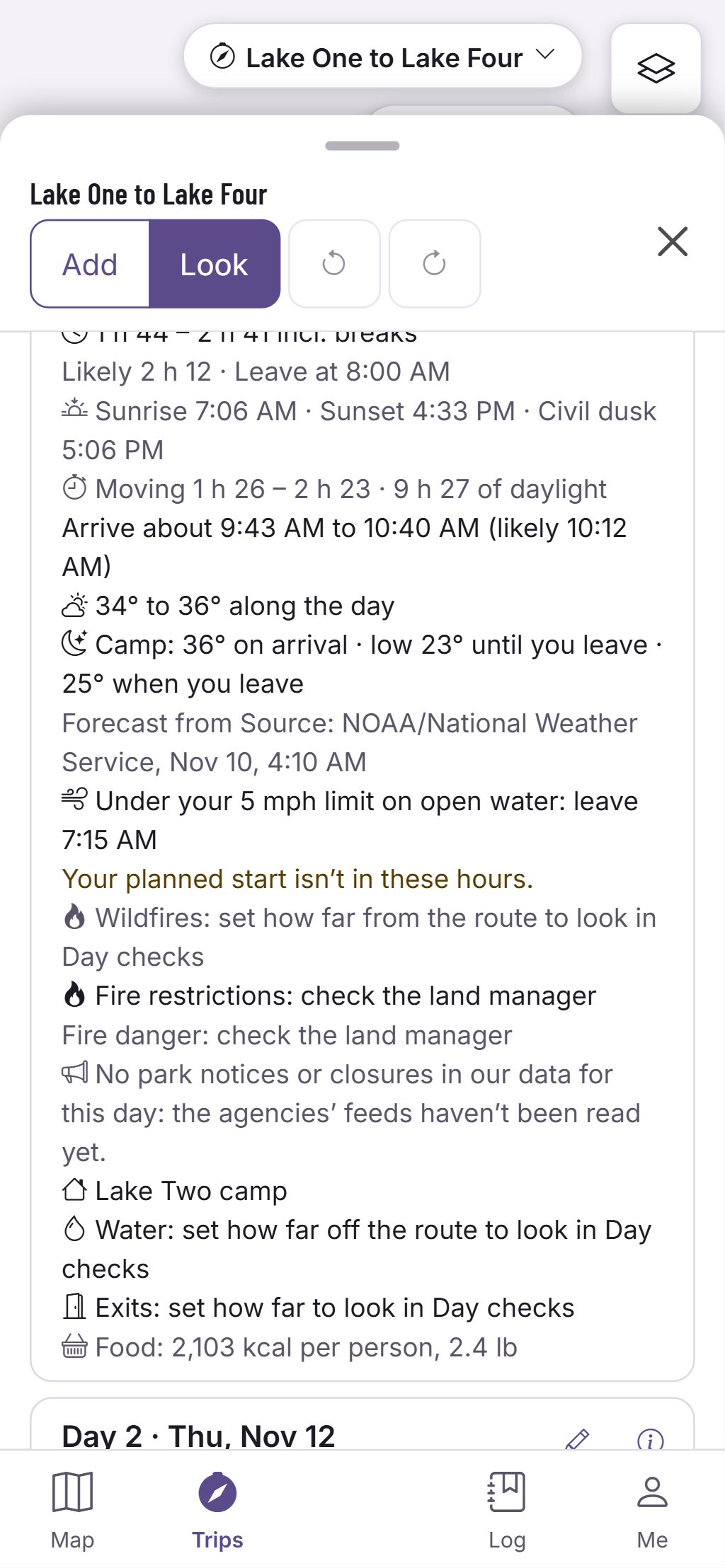
Set the most wind you’ll paddle in, on open water, in the trip’s day checks. Each day card then lists the hours when every open-water leg of the day is under your limit in the forecast, and the start times that fit, inside the day’s daylight. With no limit set, the card shows the forecast wind on each crossing and nothing more. Your limit is your setting, not ours.
Keep spare days
Add spare days to the trip for wind or weather. When no hour of a day fits your limit, the card says so and shows the spare days you have left. Use one from the day’s card and the rest of the plan moves with it.
Wind and your pace
Times assume calm water, because no published rule says how much a headwind slows a paddler. If you know from experience how much it slows you, set your own headwind slowdown in the trip’s assumptions, and legs into the wind take longer.
See conditions and wind windows. More about HuntGrid Backcountry.
Sources
The facts and figures above come from these official pages, read on November 10, 2026. The words and drawings are ours.
Questions
Still have a question? Read the HuntGrid Backcountry help pages or email support@huntgrid.net.
Does HuntGrid Backcountry tell me when it’s calm enough to cross?
No. It shows the forecast wind and waves on each open-water leg beside the limit you set yourself, and the hours under it. The call on the water is yours.
What if I have no signal on the trip?
Download the trip before you go: the last forecast stays on the phone with its age. Watch the water and the sky, and check the forecast again when you have a signal.
Your next trip starts on the map
Create a free account and open HuntGrid Backcountry in your browser. The same account works for every HuntGrid app.
Already have an account? Sign in