 HuntGrid
Guide · 9 min read
How to hunt the wind
A deer, an elk or a moose trusts its nose more than its eyes. You can get away with a little movement or a little noise, but not with your scent blowing into an animal’s face. Hunting the wind is the one skill that pays off on every hunt.
Map data © OpenStreetMap contributors, © OpenMapTiles; terrain: Copernicus WorldDEM-30 (credits)
On this page
Read the wind the right way round
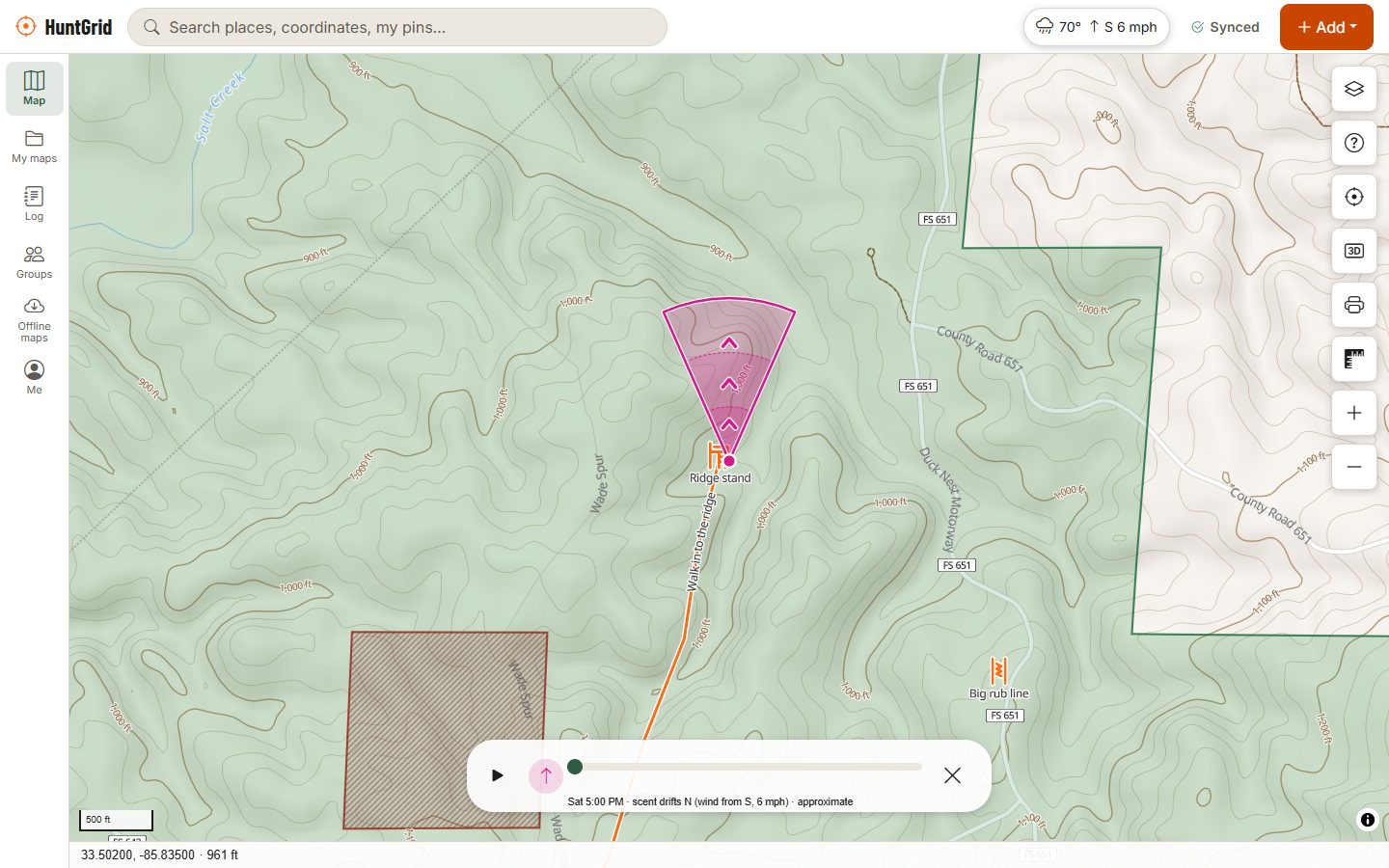
Wind is named for where it comes from. A north wind blows from the north toward the south, so your scent drifts south of you. Forecasts give the wind's direction and speed, and gusts can swing it by a wide angle. On a map, picture a cone of scent spreading downwind from you, narrow near you and wider with distance. Anything standing in that cone can smell you; anything outside it usually can't.
A forecast tells you the general wind. The ground decides what it does near you. Ridges, draws, timber edges, lakes and fields bend it, slow it and make it eddy. That's why experienced hunters check the forecast at home and then check the wind again where they sit, with a puff bottle of unscented powder, a strand of milkweed fluff or a light thread tied to the bow or stand.
What scent control can and can't do
Washing clothes in unscented detergent, storing them away from cooking and gas smells, showering before the hunt and not sweating on the walk in all reduce how much scent you give off. They're worth doing. But no spray, suit or soap makes you invisible to a nose that is far more sensitive than ours. Treat scent control as a way to shrink your cone, not erase it, and keep the wind as your first rule: if the wind is wrong for a stand, hunt somewhere else.
Thermals: the wind that changes with the sun
In hilly country, air moves along the slopes as the ground heats and cools. These currents are called thermals, and on calm days they can matter more than the forecast wind.
- Before and around sunrise, cool air slides downhill. Your scent drifts down into the draws and bottoms.
- Once the sun warms a slope, the air over it rises and your scent drifts uphill. East-facing slopes warm first; slopes in shade can stay cold for hours.
- In the evening, as slopes lose the sun and cool, the flow turns downhill again.
- During the switch, scent can swirl in every direction. Those half-hours are when many hunters get winded without understanding why.
Thermals explain a classic pattern. A hunter sitting high on a ridge at dawn is safe while the air sinks below him toward the bottoms, as long as he didn't walk through them to get there. The same hunter sitting low in a creek bottom in the evening has his scent sliding down the drainage, toward whatever comes off the ridge to feed.
Plan the walk in and the walk out
Many hunts are lost before the hunter climbs into the stand. Your entry route matters as much as the stand:
- Walk in with the wind in your face or across your path, never blowing from you toward where the animals bed or feed.
- Don't cross the trails, the field edge or the bedding cover you're hunting. Loop around, and use creeks, ditches, low ground and thick cover to stay out of sight.
- Morning: get in early and quietly, without pushing deer off the food on their way to bed.
- Evening: plan the exit too. Climbing down while deer are still in the field in front of you teaches them about that stand. A route out the back, or a friend driving in to pick you up, can save a spot.
Put stands where the wind works
Hunt the downwind side of the travel
Set up so the trail, scrape line or funnel you're watching is upwind or crosswind of you, and your scent blows away from where deer come from and where they're going. A crosswind along a travel route is often the best wind of all.
Expect deer to use the wind too
Mature bucks often travel with the wind in their favour, cruising the downwind side of doe bedding or food to scent-check it. If you sit right on the obvious trail, a buck may pass on the downwind side and smell you first. Setting up a little further downwind of the trail, covering both, is a common answer.
Have a stand for each wind
One stand per spot means hunting it in the wrong wind sooner or later. Two or three setups around the same area, each good for a different wind, let you hunt it more often without educating the deer. When you save a stand in HuntGrid, you note the winds it's good for, and the app can alert you when the forecast wind suits it.
Whatever the wind, follow your jurisdiction's rules on tree stands, blinds and blaze orange, and wear a full-body harness whenever you're off the ground.
How HuntGrid helps you play the wind
HuntGrid's wind tools are built around this kind of planning:
- A scent cone from any stand or spot, drawn from the hourly forecast, with a time slider to see where your scent goes at dawn, midday and last light.
- Wind arrows across the map and forecast layers for wind and gusts, so you can see a change coming.
- A thermals hint for a spot on a slope: whether air is likely rising or falling, which way scent drifts and roughly when it changes. It's guidance from the sun and the terrain, not a measurement.
- A daily 1 to 5 hunt score for each stand, with plain reasons such as wind fit, pressure trend and temperature change, plus hourly weather.
Use it to choose which stand to hunt tonight, then trust what the puff bottle tells you when you get there.
Wind for other game
In the mountains, elk and mule deer hunters live by thermals, and they plan stalks on bedded animals around which way the air is moving at that hour. Moose hunters calling from a lake shore know a bull often circles downwind before he shows, so they keep an eye on that side. Turkeys rely on eyes and ears, not noses, but wind still decides whether a bird can hear your calls. Waterfowl land into the wind, so it decides where you set the decoys and where the birds will finish.
Questions
Still have a question? Read the help pages or email support@huntgrid.net.
What is the best wind for a deer stand?
One that carries your scent away from where deer come from and where they are heading. A crosswind along the trail or funnel you are watching is often best. It depends on the stand, so note the good winds for each one.
Do thermals go up or down in the morning?
Down at first light, while slopes are cool, then up once the sun warms the slope. East-facing slopes switch first. In the evening they flow downhill again as slopes cool.
Does scent control spray work?
Reducing your scent helps, but nothing makes you scent-free to a deer's nose. Use scent control to shrink your scent cone and still hunt the wind.
Can I hunt a stand with the wrong wind?
You can, but every time deer smell you there, they learn to avoid it. Having stands for different winds lets you leave a spot alone until the wind is right.
How does a scent cone work in a hunting app?
It draws the area downwind of your stand where your scent is likely to drift, from the forecast wind for each hour. In HuntGrid you can step through the hours with a time slider and see a thermals hint for spots on a slope.
Your next hunt starts on the map
Create a free account, download your area and head out. No credit card, no per-state fees.
Already have an account? Sign in