 HuntGrid
Guide · 7 min read
Solunar tables explained
Solunar tables promise the best hours to hunt and fish, worked out from the moon. Here is what they actually calculate, how to read them, and an honest look at how much they should change your plans.
Map data © OpenStreetMap contributors, © OpenMapTiles; terrain: Copernicus WorldDEM-30 (credits)
On this page
What solunar theory says
Solunar theory holds that fish and game are more active at certain times of day set by the moon's position, much as the moon drives the tides. The idea was popularized by the American outdoor writer John Alden Knight in the 1930s, and his tables are the ancestor of every solunar chart and app today. The name joins "solar" and "lunar": the theory looks at the moon, and many versions also give extra weight to periods that fall near sunrise and sunset.
Major and minor periods
Each day a solunar table lists up to four periods, built from four moments in the moon's day:
- Major periods are centred on the moon overhead (when it crosses the meridian, highest in the sky) and underfoot (the same moment on the opposite side of the Earth). They last about two hours, an hour either side.
- Minor periods are centred on moonrise and moonset. They last about an hour, half an hour either side.
That's exactly how HuntGrid computes them, from the moon's real position for the place you pick. Because the moon rises roughly 50 minutes later each day on average, the periods slide later from one day to the next and come back around about once a month. Some days have only three periods, when the moon doesn't rise or set within that calendar day. Other tables may use slightly different lengths, so don't be surprised if two charts disagree by a few minutes.
How to read a day on the table
- Check the place and time zone. Solunar times are local: they change with your longitude and latitude, so use a table computed for where you'll hunt, shown in that place's time.
- Read the times as centres, not switches. A major listed from 6:10 to 8:10 doesn't mean nothing moves at 8:11. If the theory holds at all, activity would build and fade around the middle.
- Lay the periods over your hunting window. A major at 2 a.m. is no help to a deer hunter; one that overlaps the first or last hour of legal light is the one to notice.
- Read the rest of the day too. The same table gives sunrise, sunset and first and last light, which matter to every hunt whatever you think of the moon.
Where the moon phase comes in
Most solunar tables rate days around the new and full moon as the best. The phase also decides when the periods fall, which is worth understanding:
- Near the new moon, the moon rises and sets close to the sun. Minors land near sunrise and sunset, and majors near midday and midnight.
- Near the full moon, the moon rises around sunset and sets around sunrise. Minors again fall near dawn and dusk, with majors around midnight and midday.
- Near the quarter moons, it flips: the moon is overhead or underfoot near sunrise and sunset, so the majors line up with first and last light.
These are rough patterns that shift with the season and your latitude, which is why a table computed for your exact spot beats a generic calendar.
What the day rating means
HuntGrid gives each day a rating from 0 (poor) to 4 (excellent). It counts what solunar hunters look for:
- The moon phase: 2 points within about a day of the new or full moon, 1 point within about three days.
- A major period at dawn or dusk: 1 point when a major overlaps the hour either side of sunrise or sunset.
- A minor period at dawn or dusk: 1 point when a minor does the same.
The idea is simple: a solunar period that lines up with the low light when deer and many other animals are already moving is the one most worth a hunter's attention.
Do solunar tables work? An honest answer
The evidence is mixed. Researchers who have tracked deer and other game against moon phase and position have reported anything from small effects to no clear pattern at all, and plenty of experienced hunters swear by the tables while others ignore them. What nobody disputes is that other things move game more reliably:
- Weather: a cold front, a sharp temperature drop, the hours before and after a storm, and the pressure trend.
- Season and biology: the rut, the timing of food sources like acorns or crops, and daylight length.
- Hunting pressure: pressured animals shift their movement to the dark hours and the hardest cover, whatever the moon is doing.
- Wind: a great day on the calendar is still wasted on a stand with the wrong wind.
So use solunar times the way most good hunters do: as a tie-breaker. If two days look equally good on the weather, take the better solunar day. If you can only sit for a few hours, a major period overlapping a good wind is a fine reason to choose those hours. During the rut, a major at midday is a reasonable excuse to stay on stand through lunch. But never skip a perfect cold-front morning because a table says it's a 1.
Test it on your own ground
The best answer to "do solunar tables work?" is your own data. Log your sightings and harvests, and look at your trail camera photos against the hour, the moon and the wind. HuntGrid's hunt log and trail camera import show activity by hour, moon and wind, so after a season or two you can see whether the moon matters where you hunt.
Solunar times in HuntGrid
- The free solunar table gives sunrise, sunset, first and last light, the moon phase and the major and minor periods for any place, for the next 7 days, with no account needed.
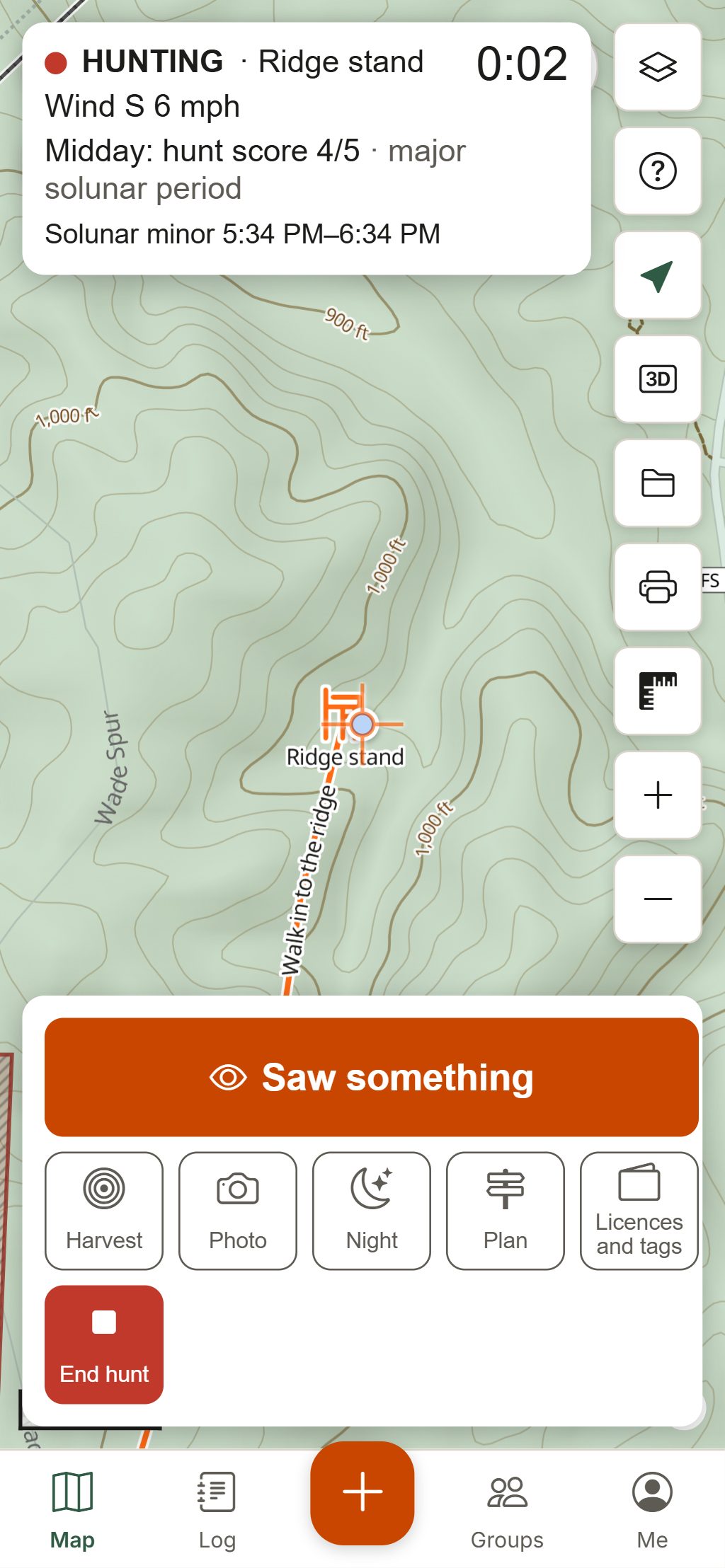
- In the app, the Sun & moon panel shows the periods and the day rating for any spot on the map, and Hunt Mode shows the next solunar period on your stand.
- The daily 1 to 5 hunt score for each stand counts a solunar period at dawn or dusk as one reason among others, next to wind fit, pressure trend and temperature change, rather than letting the moon decide on its own.
Questions
Still have a question? Read the help pages or email support@huntgrid.net.
What are major and minor solunar periods?
Major periods last about two hours, centred on the moon overhead and underfoot. Minor periods last about an hour, centred on moonrise and moonset. They shift later by roughly 50 minutes a day on average.
Which moon phase is best for deer hunting?
Solunar tables favour the days around the new and full moon. Research on moon phase and deer movement is mixed, and weather, the rut and hunting pressure usually matter more.
Are solunar tables accurate?
The times are accurate astronomy: the moon really is overhead at the listed time. Whether game moves more then is the debated part. Use them as a tie-breaker, not a rule.
What is a good solunar day rating?
In HuntGrid, 3 or 4 out of 4 means a day near the new or full moon with solunar periods at dawn or dusk. It is one input among many: check the wind and weather too.
Where can I get a free solunar table for my location?
HuntGrid's free solunar table, on this site, gives major and minor periods and sun and moon times for any place for the next 7 days, with no account needed.
Your next hunt starts on the map
Create a free account, download your area and head out. No credit card, no per-state fees.
Already have an account? Sign in