 HuntGrid
Northern pike and muskellunge
The pike and muskie fishing app
Pike and muskie are ambush hunters with a mouthful of teeth. HuntGrid Fishing keeps your weed edges and big-fish spots private, logs every fish in three taps, and shows how to tell the two apart and release them well.
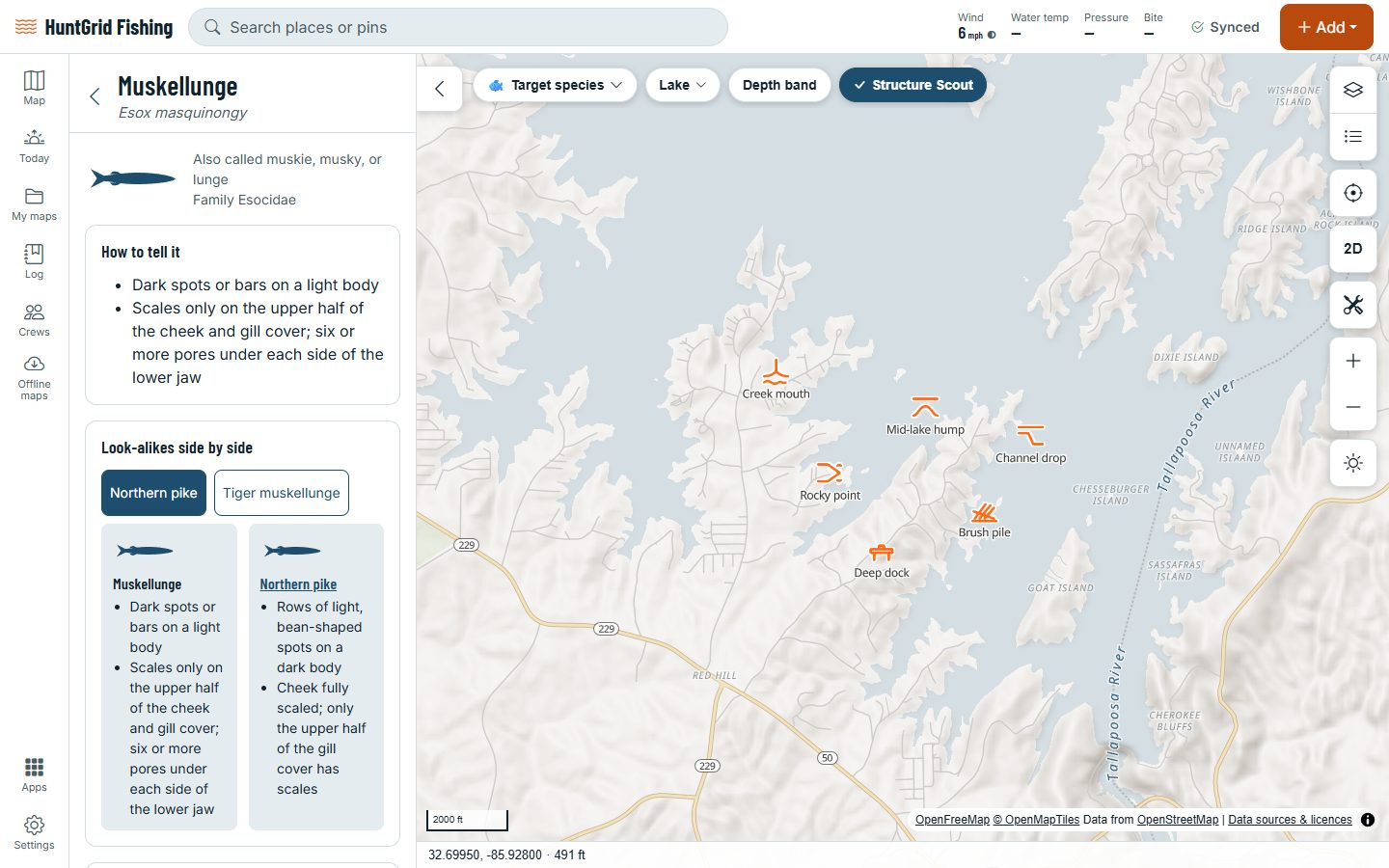
Map data © OpenStreetMap contributors, © OpenMapTiles; terrain: Copernicus WorldDEM-30 (credits)
Know the toothy ones
Cousins with the same plan: wait, then strike.
Ambush hunters
Both lie in wait along weed edges, in weedy bays and near drop-offs, then strike fast. Big ones also roam open water after schools of baitfish.
Pike: the northern one
Northern pike live across the north of North America, Europe and Asia, handle cold water well and are a favourite through the ice.
Muskie: fewer, bigger
Muskellunge are native to a smaller range in eastern North America, are fewer in number, and are known for following a lure to the boat without biting.
Early spring spawners
Pike spawn very early in spring, often right after the ice goes out, in flooded marshes and shallow, weedy bays; muskie spawn a little later.
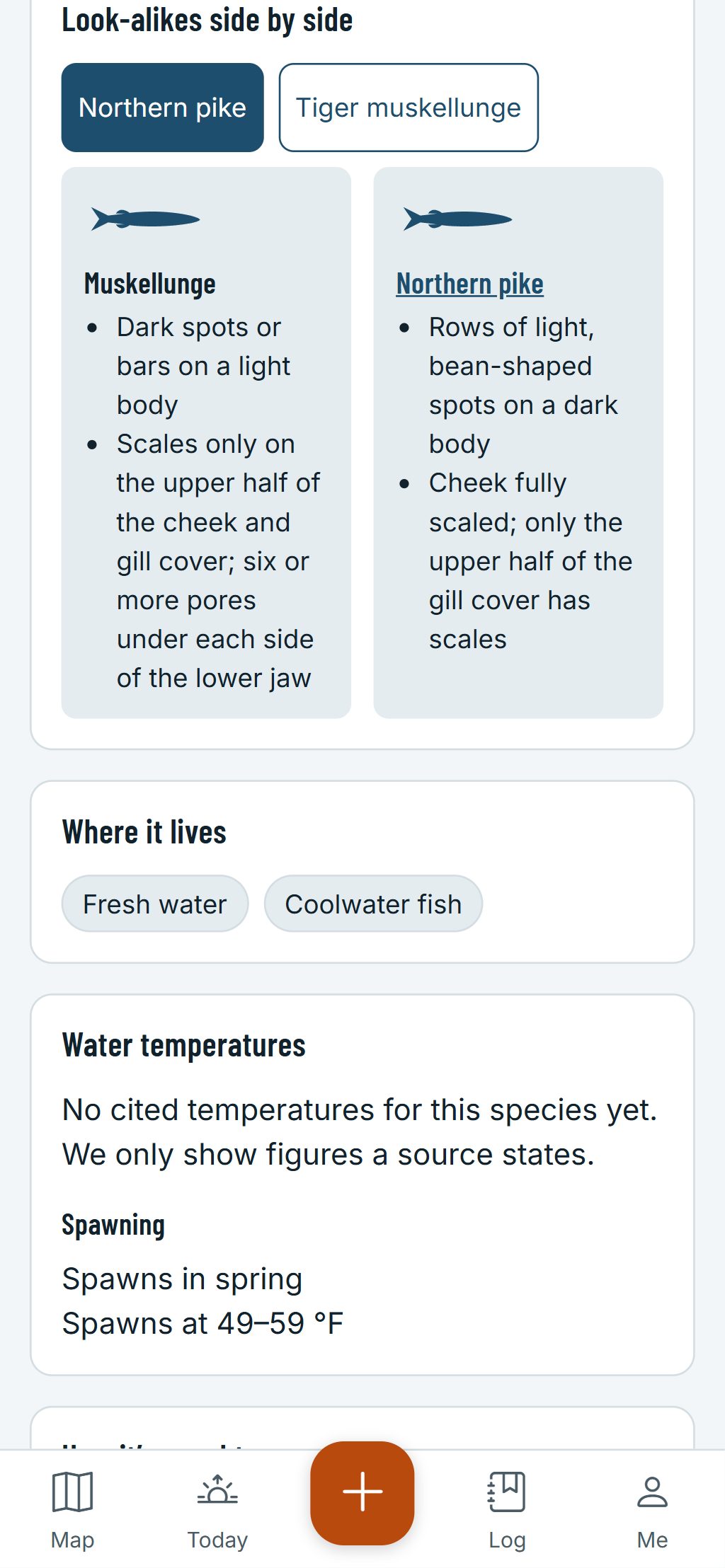
Map data © OpenStreetMap contributors, © OpenMapTiles; terrain: Copernicus WorldDEM-30 (credits)
Species guide
Pike or muskie? The guide shows you
The species guide in HuntGrid Fishing works with no signal. Each species has its own page (open this species in the app):
- The marks that tell them apart: a northern pike has rows of light, bean-shaped spots on a dark body; a muskellunge has dark spots or bars on a light body, and fewer scales on its cheek.
- Look-alikes side by side, the chain pickerel included.
- Their habitat and the techniques that catch each one.
- A question key: answer a few questions about the fish in your hand and it narrows down the candidates.
- Waters near you where agency surveys or stocking records show the species, with the year.
Pike and muskie seasons and size limits vary by state, province and water, and some waters are catch and release only. HuntGrid never guesses them: the official regulations always have the final word.
How pike and muskie anglers use HuntGrid Fishing
Weed edges and big-fish spots
Mark weed lines, bays, points and the spot where a big fish followed, with the depth, the cover and the winds each one fishes best.
Log a pike in three taps
Tap +, Catch, Northern pike: the place and time are saved, even with no signal. Add a length and the app estimates the weight, marked “est.”
Release them well
The how-to library shows how to handle and release a fish well, and how to tie the knots you need, saved offline.
Depth maps
Depth shading and contours from agency lake surveys show the weedy flats, points and drop-offs where pike and muskie wait.
Structure Scout
Points, saddles and flats beside deep water are labelled with their depth: a short list of places to try first.
Pike through the ice
Ice Mode numbers your holes, times your tip-ups and puts a big Flag up! button on screen.
Bite forecast
Today scores the bite on your favourite waters and shows the best windows, with the reasons behind each score.
Can I keep it?
Fish Check gives the rules for a pike or muskie of that length at that water today, with the official source.
Personal bests
Your longest pike and muskie, and the day you caught your first muskie.
Offline lakes and rivers
Download a lake or a stretch of river in one tap: its map and your spots work with zero bars.
Questions
Still have a question? Read the HuntGrid Fishing help pages or email support@huntgrid.net.
What is the best app for pike and muskie fishing?
The one that fits how you fish. HuntGrid Fishing keeps your big-fish spots private, logs a catch in three taps and carries a species guide and a how-to library that work offline. It’s free: try it on your own lake before you decide.
How do I tell a pike from a muskie?
Start with the pattern: a pike has light spots on a dark body, a muskie dark marks on a light body. Then the cheek: a pike’s is fully scaled, a muskie’s only on its upper half. Under the lower jaw a muskie usually has six or more pores on each side.
How do I release a big pike or muskie?
Have long pliers and a big net ready before you cast, keep the fish in the water as much as you can, support its body when you lift it, and let it swim off on its own. The how-to library has the steps, offline.
Does HuntGrid Fishing show pike and muskie limits?
Fish Check gives the rules for a pike or muskie at a water on a date, with the official source. Rules a person hasn’t checked yet are labelled as not verified. The official regulations always have the final word.
Your next fishing trip starts on the map
Create a free account and open HuntGrid Fishing in your browser. The same account works for HuntGrid Hunt.
Already have an account? Sign in