 HuntGrid
Through the ice
The ice fishing app for perch, walleye, pike and more
Fish keep feeding all winter. HuntGrid Fishing helps you know the fish under your feet and where they hold through the season, numbers your holes with the depth under each, times your tip-ups and keeps your spots private, with or without a signal.
Map data © OpenStreetMap contributors, © OpenMapTiles; terrain: Copernicus WorldDEM-30 (credits)
Who bites under the ice
Many fish slow down in winter, but few stop eating.
Perch and panfish
Yellow perch, black crappie and bluegill school over weed flats and soft bottom and bite all winter: a good place to start.
Walleye at dusk, pike on the flags
Walleye feed most around dawn and dusk, and snow on the ice can help them feed by day. Northern pike often take the bait under a tip-up in daylight.
Lake trout and whitefish go deep
Lake trout, lake whitefish and cisco roam the cold, deep basins of big lakes, and many anglers jig for them over deep water.
Winter spawners
Burbot spawn under the ice in the heart of winter, and Atlantic tomcod run up tributaries of the St. Lawrence to spawn, where villages of shelters fish for them. Rainbow smelt run up streams soon after the ice goes.
Map data © OpenStreetMap contributors, © OpenMapTiles; terrain: Copernicus WorldDEM-30 (credits)
Species guide
What came up the hole? The guide shows you
The species guide in HuntGrid Fishing works with no signal. Each species has its own page (open this species in the app):
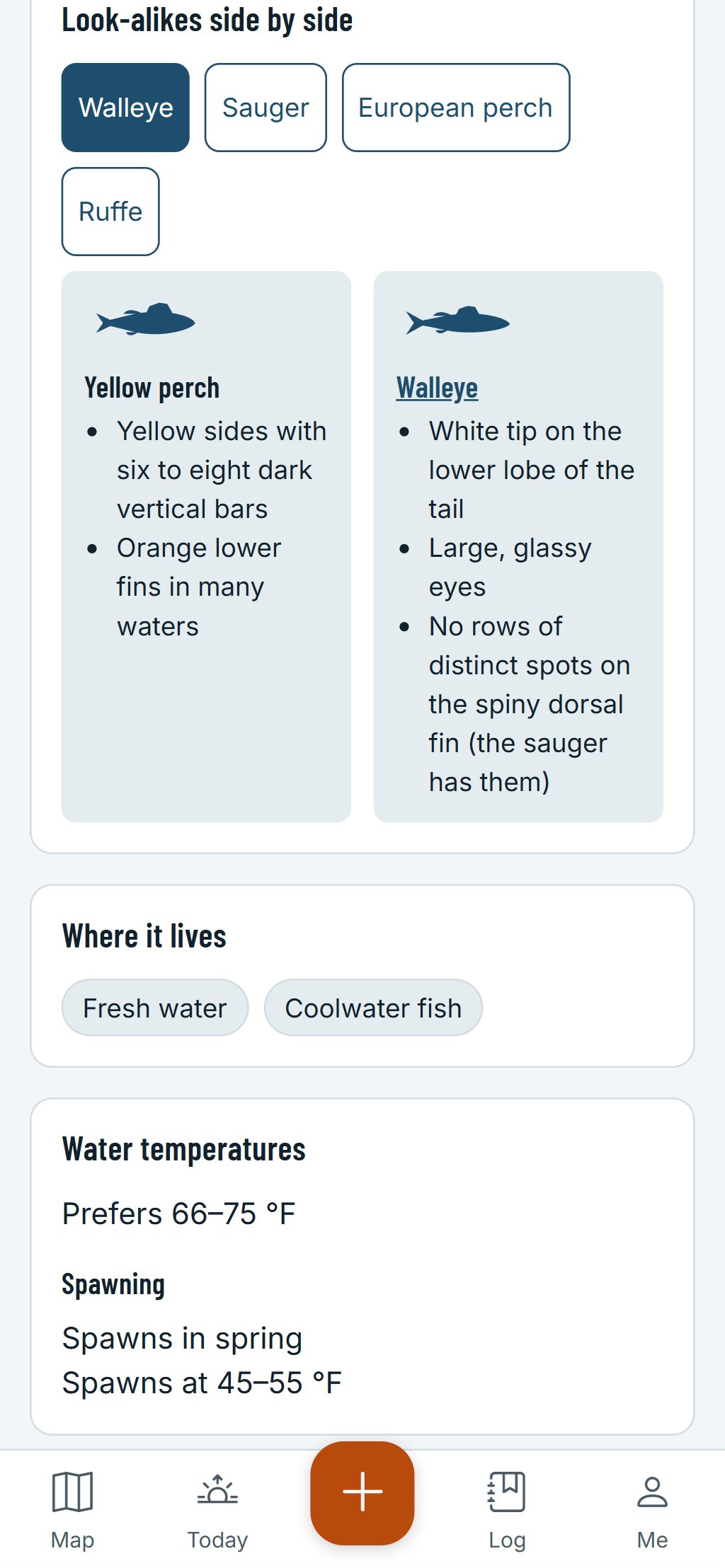
- The marks that tell them apart, like the yellow perch’s six to eight dark bars, or the burbot’s single barbel on the chin.
- Look-alikes side by side, like a yellow perch and a walleye, or a lake whitefish and a cisco.
- Their habitat, the techniques that catch them, ice fishing included, and the water temperatures they prefer, with the source, where one gives them.
- A question key: answer a few questions about the fish in your hand and it narrows down the candidates.
- Waters near you where agency surveys or stocking records show the species, with the year.
Ice is never 100% safe. HuntGrid never tells you ice will hold you and never shows a guessed thickness. Seasons, the number of lines and shelter rules vary by water: the official regulations always have the final word.
How ice anglers use HuntGrid Fishing
Ice Mode
Big buttons for cold hands. Mark a hole and it gets a number, and the depth under it from the lake’s depth map where there is one.
Tip-up timers and Flag up!
Each tip-up gets a timer, and one big Flag up! button logs the flag right when it goes up.
Lines against the limit
Where we have the rules for that water, Ice Mode shows your lines in use against the limit, labelled unverified until a person checks it. Where we don’t, it says so.
Log a perch in three taps
Tap +, Catch, Yellow perch: the place and time are saved, even on the ice with no signal. Add a length and the app estimates the weight, marked “est.”
Ice fishing how-to, offline
The how-to library covers ice fishing from first ice to late ice, with jigging and tip-ups, and how to handle and release a fish.
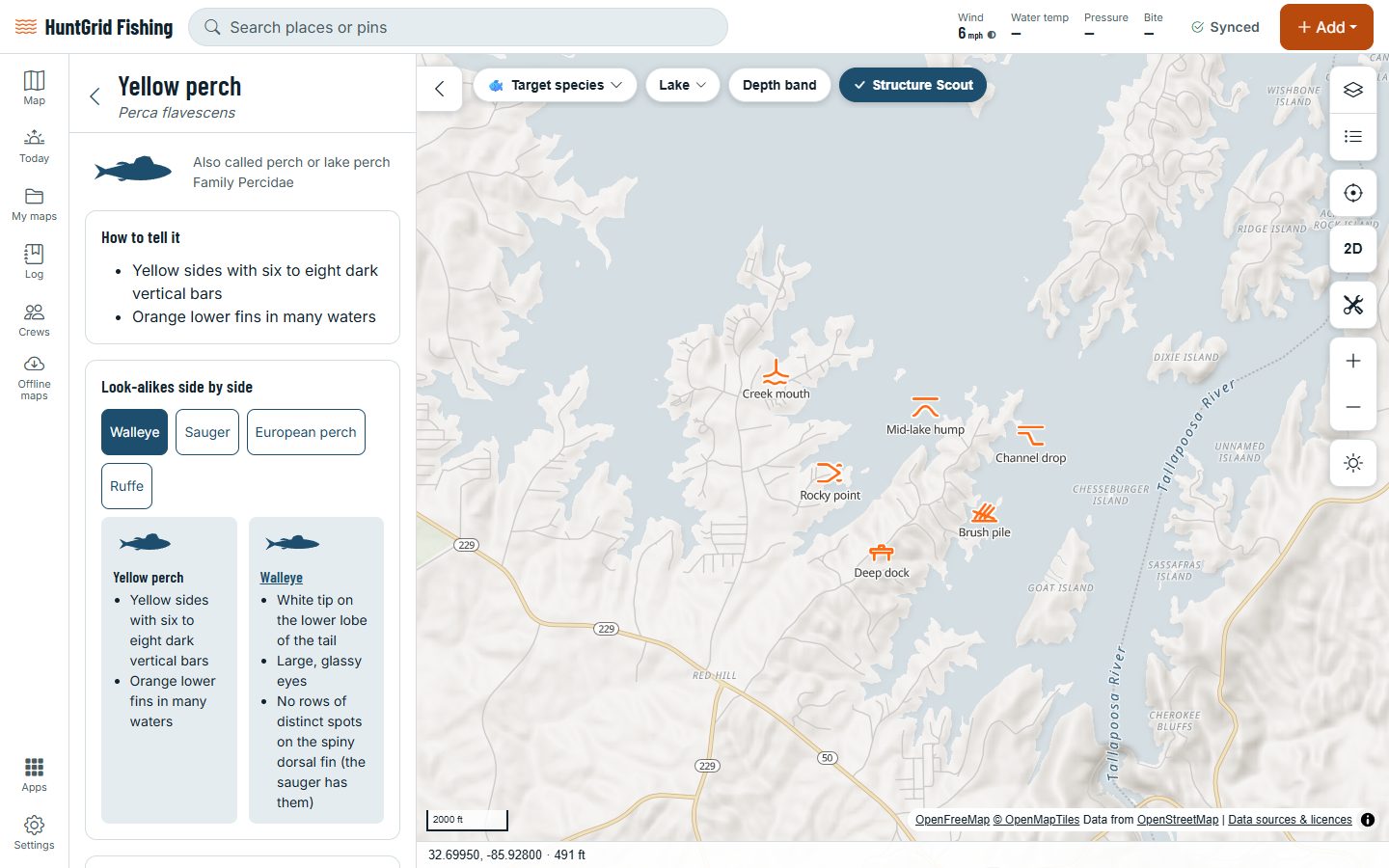
Structure Scout
Humps, points and flats beside deep water are labelled with their depth: a short list of places to drill first.
Ice reports
Anglers’ reports of thickness, clear or white ice, snow and slush, placed on the lake, never on their exact spot, with their age. They expire.
Ice status
Open, forming, likely ice-covered or breaking up: a state, never a thickness.
Ice-on and ice-off dates
On lakes with open freeze and thaw records: when the lake usually freezes and thaws, and the latest winter against the usual.
Ice guide, offline
Official thickness guidance with its source, self-rescue and what to bring, with no signal.
Shelter rules
Shelter rules and removal dates by area, and a reminder before the date for a shelter you’ve saved.
Can I keep it?
Fish Check gives the rules for a perch, walleye or pike of that length at that water today, with the official source.
Personal bests
Your biggest perch, walleye and pike through the ice, and the first of each species you logged.
Offline lakes and rivers
Download a lake or a stretch of river in one tap: its map and your spots work with zero bars.
Questions
Still have a question? Read the HuntGrid Fishing help pages or email support@huntgrid.net.
What is the best app for ice fishing?
The one that fits how you fish. HuntGrid Fishing has Ice Mode with numbered holes and tip-up timers, keeps your spots private, logs a catch in three taps and carries a species guide and a how-to library that work with no signal. It’s free: try it on your next day on the ice.
Will HuntGrid tell me if the ice is thick enough?
No. Ice is never 100% safe. It changes from one step to the next, so the app never says ice will hold you and never shows a guessed thickness. Check it yourself as you go and follow your local authority’s guidance.
Where do fish hold under the ice?
It changes through the winter. At first ice many fish stay in shallow, weedy bays and along the weedline; by mid-winter many move to deeper basins and humps; at late ice they move back toward the shallows. Drill a line of holes from shallow to deep to find them.
Does HuntGrid Fishing show limits for ice fishing?
Fish Check gives the rules for a fish at a water on a date, with the official source. Rules a person hasn’t checked yet are labelled as not verified. The official regulations always have the final word.
Your next fishing trip starts on the map
Create a free account and open HuntGrid Fishing in your browser. The same account works for HuntGrid Hunt.
Already have an account? Sign in