 HuntGrid
Brook, rainbow, brown and lake trout
The trout fishing app for streams and cold lakes
Trout need cold, clean water, and the best of it is often far from a cell tower. HuntGrid Fishing keeps your stream and lake spots private, logs every trout in three taps, and carries the species guide and the how-tos with you.
Map data © OpenStreetMap contributors, © OpenMapTiles; terrain: Copernicus WorldDEM-30 (credits)
Know your trout
Four fish, one need: cold water.
Cold, clean water
Trout need cold, well-oxygenated water: spring-fed creeks, mountain streams, tailwaters and deep, cold lakes. Warm spells stress them, so many anglers fish early or give them a rest.
Trout and chars
Brook trout and lake trout are chars, cousins of the Arctic char. Brown trout came from Europe and rainbow trout from the Pacific side; both are now stocked widely.
Fall and spring spawners
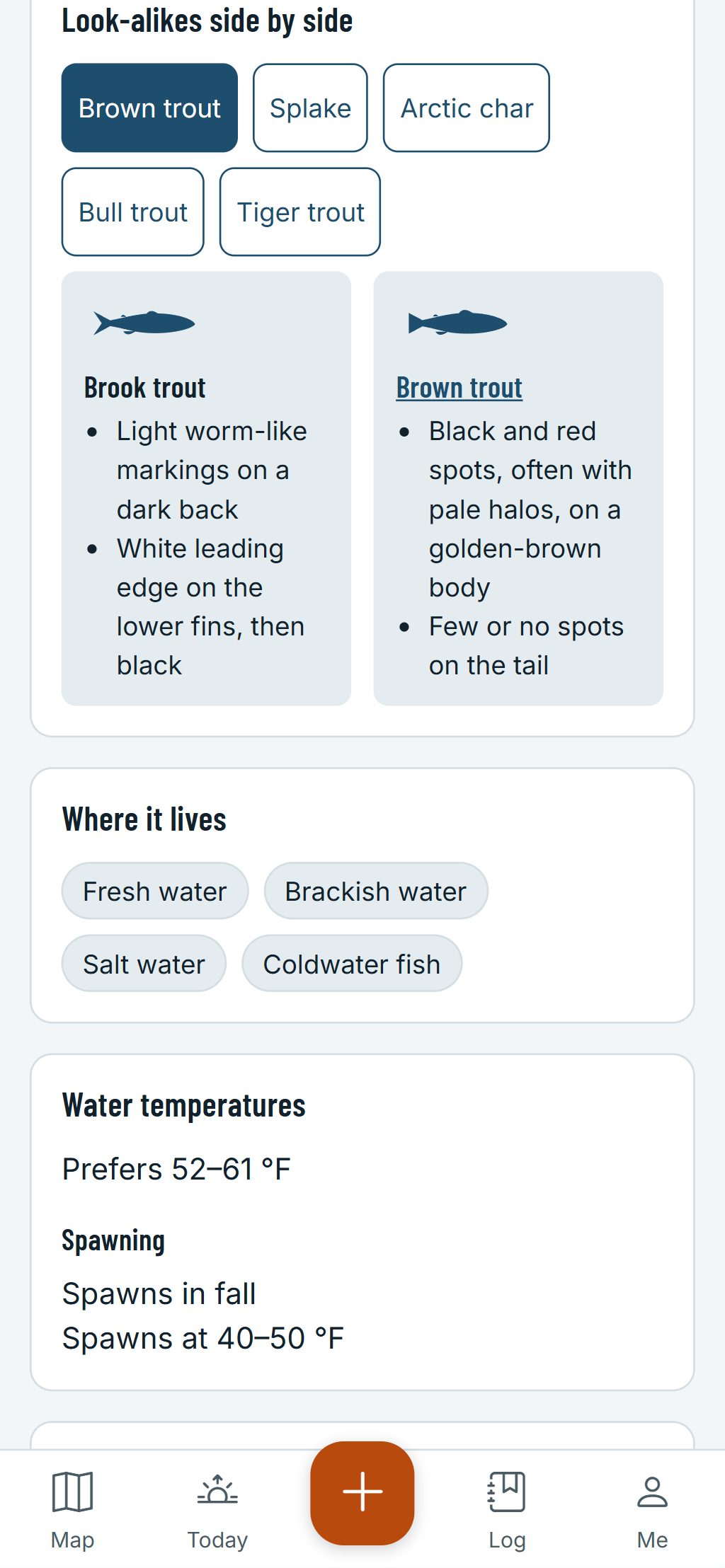
Brook, brown and lake trout spawn in the fall; most rainbow trout spawn in spring. Spawning fish and their gravel nests, called redds, are best left alone.
Lake trout go deep
In summer lake trout stay in the deep, cold water of big lakes, then come shallower in fall and after ice-out. Many anglers troll or jig deep for them, and fish them through the ice.
Map data © OpenStreetMap contributors, © OpenMapTiles; terrain: Copernicus WorldDEM-30 (credits)
Species guide
Which trout is it? The guide shows you
The species guide in HuntGrid Fishing works with no signal. Each species has its own page (open this species in the app):
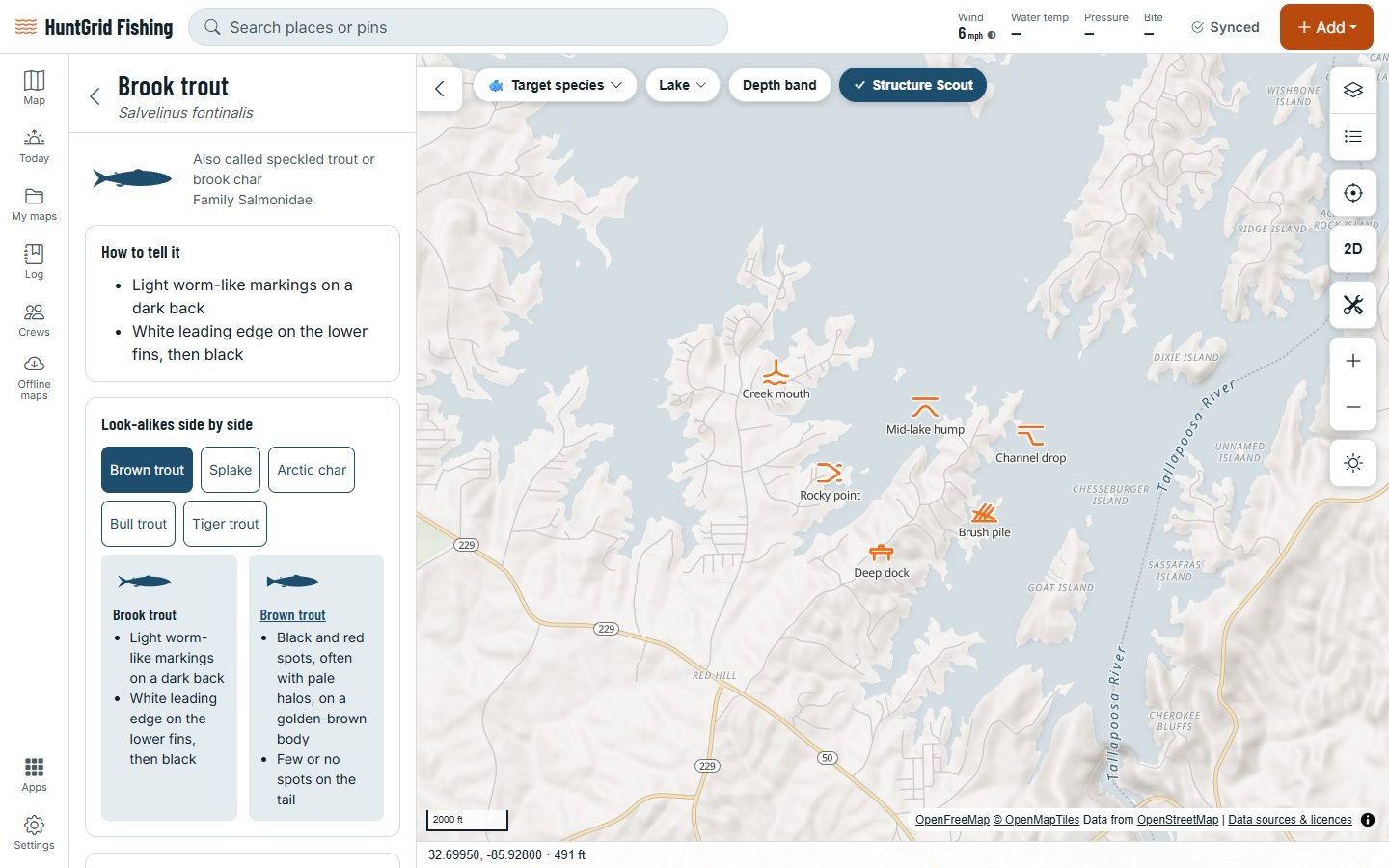
- The marks that tell them apart: worm-like markings on a brook trout’s back, black and red spots with pale halos on a brown trout, a pink band on a rainbow trout, light spots and a deeply forked tail on a lake trout.
- Look-alikes side by side, like the brown trout and the Atlantic salmon, or the brook trout and the splake.
- Their habitat, the techniques that catch each one, and the water temperatures they prefer, with the source, where one gives them.
- Trout stream classes from the agencies that publish them, and a notice when a stream runs warm.
- A question key: answer a few questions about the fish in your hand and it narrows down the candidates.
- Waters near you where agency surveys or stocking records show the species, with the year.
Trout rules vary by state, province and water, and often by stretch of stream: seasons, limits, tackle and bait. HuntGrid never guesses them: the official regulations always have the final word.
How trout anglers use HuntGrid Fishing
Pools, runs and riffles
Mark pools, undercut banks, springs and riffles with fishing icons, with the months and times each one fishes best. Filter your spots by species.
Log a trout in three taps
Tap +, Catch, Brook trout: the place and time are saved, even at the bottom of a valley with no signal. Note whether you kept it or let it go.
Stream how-tos, offline
The how-to library covers trout streams, rivers and lakes, the split shot and fixed float rigs, and the blood knot and double surgeon’s knot for joining line.
Hatch charts
The hatches coming up on your rivers, worked out from the water temperature.
Depth maps for lake trout
Depth shading and contours from agency lake surveys show the deep basins and steep shores where lake trout spend the summer.
Trout through the ice
Ice Mode numbers your holes with the depth under each and times your tip-ups.
Recently stocked
Waters near you stocked in the last few weeks, from agency records, with alerts for your favourite waters.
Can I keep it?
Fish Check gives the rules for a trout of that length at that water today, with the official source.
Life list and bests
The first brook, brown, rainbow and lake trout you logged, with the date, and your biggest of each.
Offline lakes and rivers
Download a lake or a stretch of river in one tap: its map and your spots work with zero bars.
Questions
Still have a question? Read the HuntGrid Fishing help pages or email support@huntgrid.net.
What is the best app for trout fishing?
The one that fits how you fish. HuntGrid Fishing keeps your stream and lake spots private, logs a catch in three taps and carries a species guide and a how-to library that work with no signal. It’s free: try it on your own water before you decide.
How do I tell a brook trout from a brown trout?
A brook trout has light, worm-like markings on a dark back and lower fins edged in white, then black. A brown trout is golden brown with black and red spots, often ringed with a pale halo, and few or no spots on its tail.
Does it work in a valley with no signal?
Yes, for what you carry: the species guide, the how-to library, your spots and your catch log work offline, and what you add syncs when you’re back in range.
Does HuntGrid Fishing show trout limits and seasons?
Fish Check gives the rules for a trout at a water on a date, with the official source. Rules a person hasn’t checked yet are labelled as not verified. The official regulations always have the final word.
Your next fishing trip starts on the map
Create a free account and open HuntGrid Fishing in your browser. The same account works for HuntGrid Hunt.
Already have an account? Sign in