 HuntGrid
Climbing guide · 4 min read
Climbing after rain: the rain at the crag, the rock, and the cautions on wet sandstone
How much rain fell at your crag, what the rock is, and what the land manager says about climbing it wet: the facts with their sources, never a verdict on the rock.
On this page
After rain, climbers ask two things: how much fell at the crag, and what the rock does when it is wet. HuntGrid Climbing answers the first with figures and their source, and the second with the land manager’s own words where they publish any. It never tells you the rock is ready: you judge that at the crag.
The rain at the crag
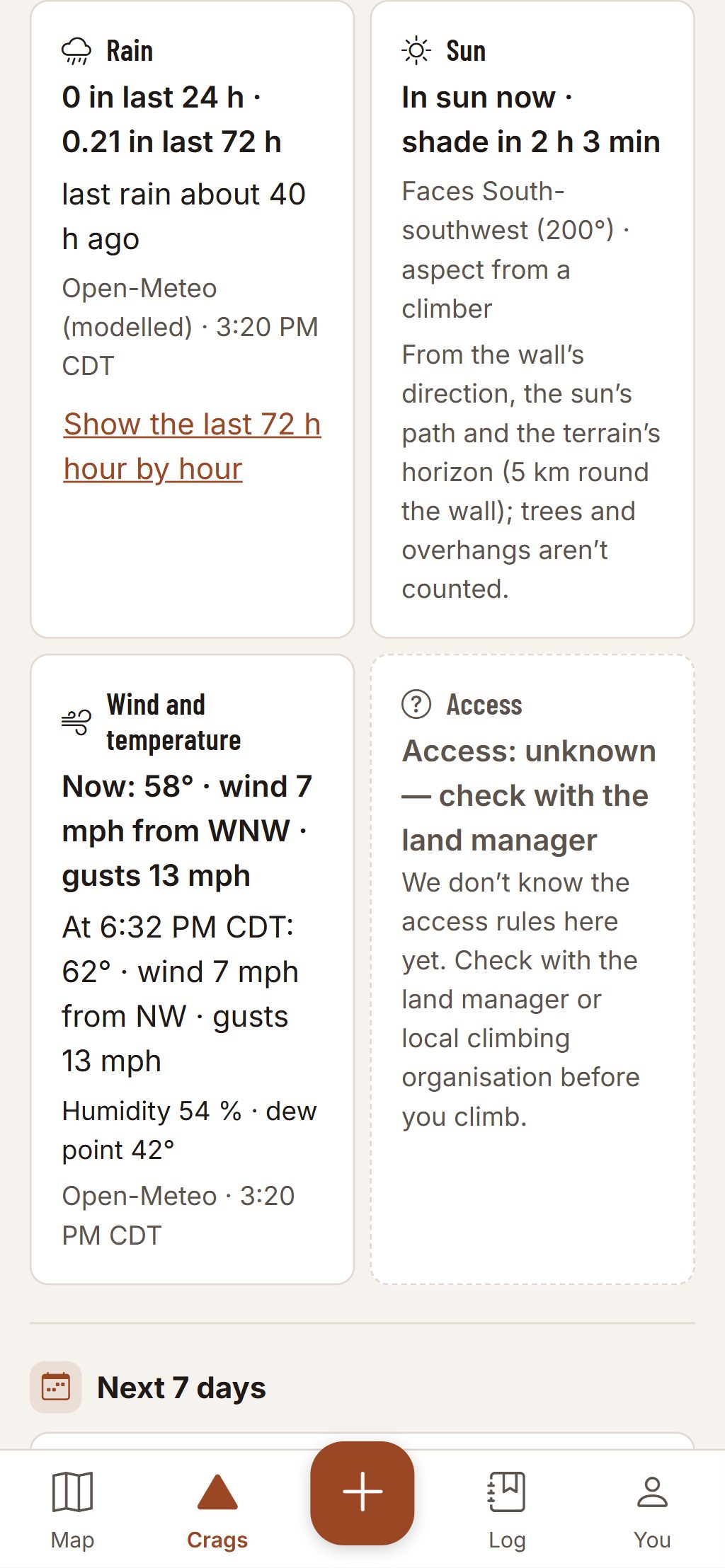
Every crag sheet shows the rain in the last 24 and 72 hours and about how long since the last rain. In the United States the figures come from NOAA’s MRMS radar and gauges, hour by hour; in Canada from Environment and Climate Change Canada’s RDPA in six-hour blocks, so the last rain reads as a range such as “6–12 h ago”. Where radar doesn’t cover the crag, a station within 15 km or a weather model fills in, and the tile says which. A gap in the data shows as “unknown”, never as 0 mm.
The rock, and where we got it
Sandstone, granite and limestone behave differently when wet, so the sheet names the rock and its source: as listed by the route source, as tagged in OpenStreetMap, as reported by a climber, or from a public geological map. A rock read from a geological map is labelled “From the geological map (regional; the crag may differ)”. With none of these, the sheet says “Rock unknown”.
What land managers say about wet sandstone
Several land managers in the American Southwest publish cautions about climbing sandstone after rain. In our words:
- Zion National Park says desert sandstone is heavily weakened when wet, asks climbers to avoid damp areas and to stay off after rainstorms, and says it often takes two or more days for the rock to be climbable again.[1] It adds that in winter the rock can take up to four days after rain or snow, and up to two days in summer.[2]
- Capitol Reef National Park says sandstone is weak when wet, and asks climbers to avoid damp areas and not to climb right after rain.[3]
- The Bureau of Land Management asks climbers not to climb when the rock is wet: wet sandstone erodes much faster, widening cracks and leaving rope grooves.[4]
- Its Monticello Field Office asks climbers in Indian Creek to wait at least 24 to 48 hours after rain before climbing on sandstone.[5]
- Its Red Rock/Sloan Canyon Field Office asks climbers in Red Rock Canyon not to climb on sandstone within 72 hours after rain, and suggests limestone instead when rain is forecast.[6]
These are summaries of each manager’s guidance for its own land. Read the page before you go: guidance changes.
How the app shows these cautions
On a crag whose point is inside the land manager’s unit and whose rock is sandstone, the conditions strip adds “Land manager’s rule on wet rock”: the issuer, its caution in our words, the issuer’s own sentence in quotation marks where its terms allow, and Read the rule. A granite crag in the same park doesn’t get it, nor does a crag whose rock we don’t know. A caution shows only once we have checked it against the page.
Granite, limestone and everywhere else
We found no land manager’s caution about granite or limestone after rain to cite, so on those crags the app shows the rain facts and the rock line, and leaves the call to you. We don’t make up a waiting time of our own.
Climbing can kill. Route information comes from other climbers and public sources and can be wrong. Check the rock, gear and anchors yourself.
Sources
The facts and figures above come from these official pages, read on October 28, 2026. The words and drawings are ours.
Questions
Still have a question? Read the HuntGrid Climbing help pages or email support@huntgrid.net.
How long after rain can I climb sandstone?
Where a land manager publishes a figure, the crag sheet quotes it: Zion says it often takes two or more days and up to four in winter, the BLM asks for at least 24 to 48 hours in Indian Creek and 72 hours in Red Rock Canyon. Elsewhere we have no figure to cite, and the app shows the rain facts only.
Will the app tell me if it’s too wet to climb?
No. It shows the rain, how long since it stopped and where those figures come from, the rock and its source, and the land manager’s caution where there is one. You judge the rock at the crag.
Is the rain figure measured at the crag?
No figure is measured on the wall itself. Radar estimates the rain over the crag; a station can be up to 15 km away; a model is labelled “modelled”. The tile always names which one it is.
Your next crag day starts on the map
Create a free account and open HuntGrid Climbing in your browser. The same account works for every HuntGrid app.
Already have an account? Sign in