 HuntGrid
Channel and flathead catfish, bullheads
The catfish fishing app for channel cats, flatheads and bullheads
Catfish find food by smell and taste, so they bite in muddy water, at night and on days other fish sulk. HuntGrid Fishing keeps your river holes and night spots private, logs every fish in three taps, and carries the bottom rigs and the species guide with you.
Map data © OpenStreetMap contributors, © OpenMapTiles; terrain: Copernicus WorldDEM-30 (credits)
Know your catfish
Whiskers, a keen nose and no scales.
A nose for food
Catfish have taste buds all over their skin and barbels, so they find food in dark, muddy water. Many anglers fish for them at night with natural or cut bait.
Channel cats like current
Channel catfish live in rivers, reservoirs and lakes, and hold in deep holes, outside bends, below dams and along sunken wood.
Flatheads hunt live fish
Flathead catfish hide in log jams and deep holes by day and hunt live fish at night, so anglers fish for them with live bait where it’s allowed.
Bullheads in every pond
The brown bullhead, black bullhead and yellow bullhead are the small catfish of ponds, marshes and weedy bays, and they bite well at night.
Map data © OpenStreetMap contributors, © OpenMapTiles; terrain: Copernicus WorldDEM-30 (credits)
Species guide
Channel cat or flathead? The guide shows you
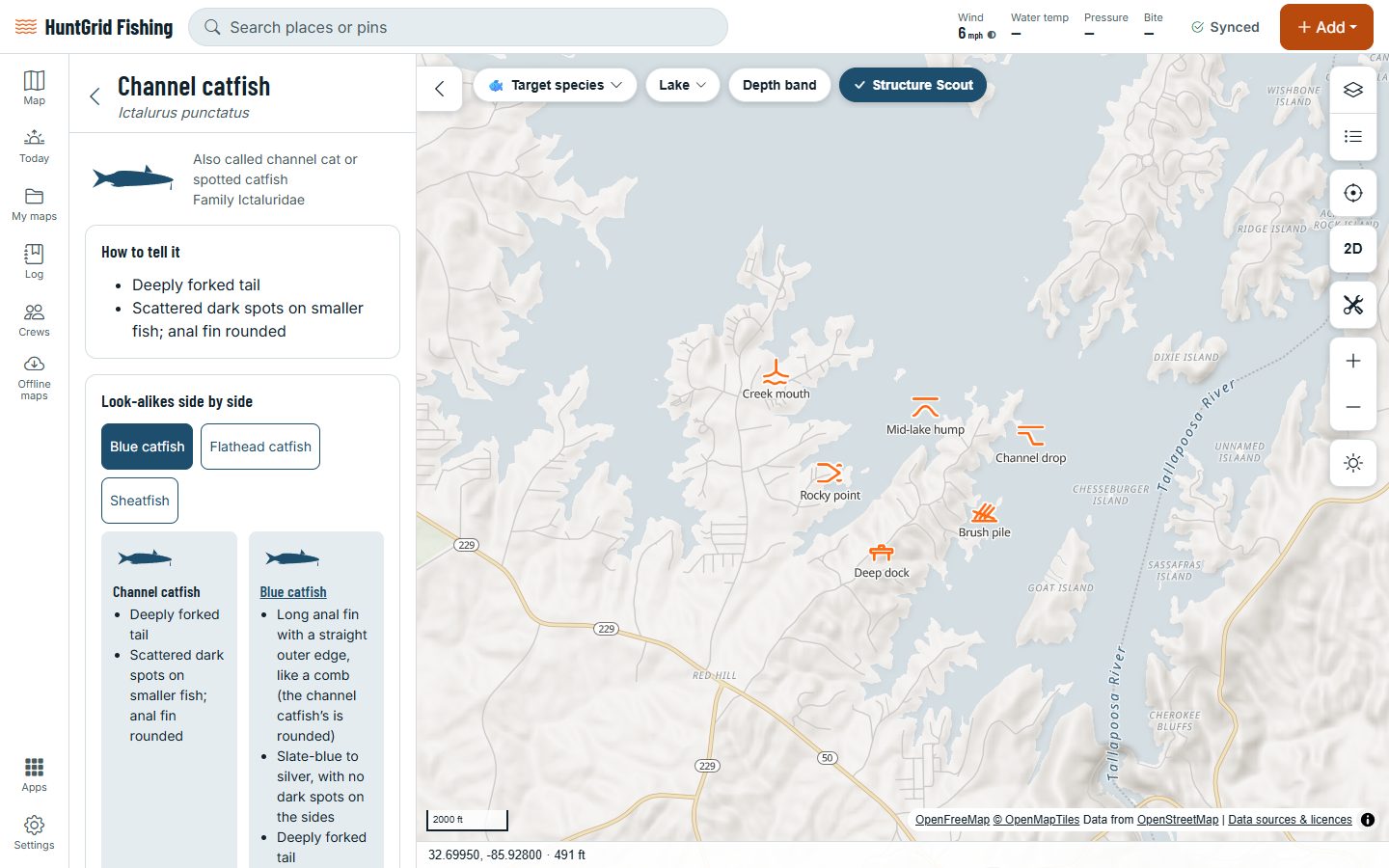
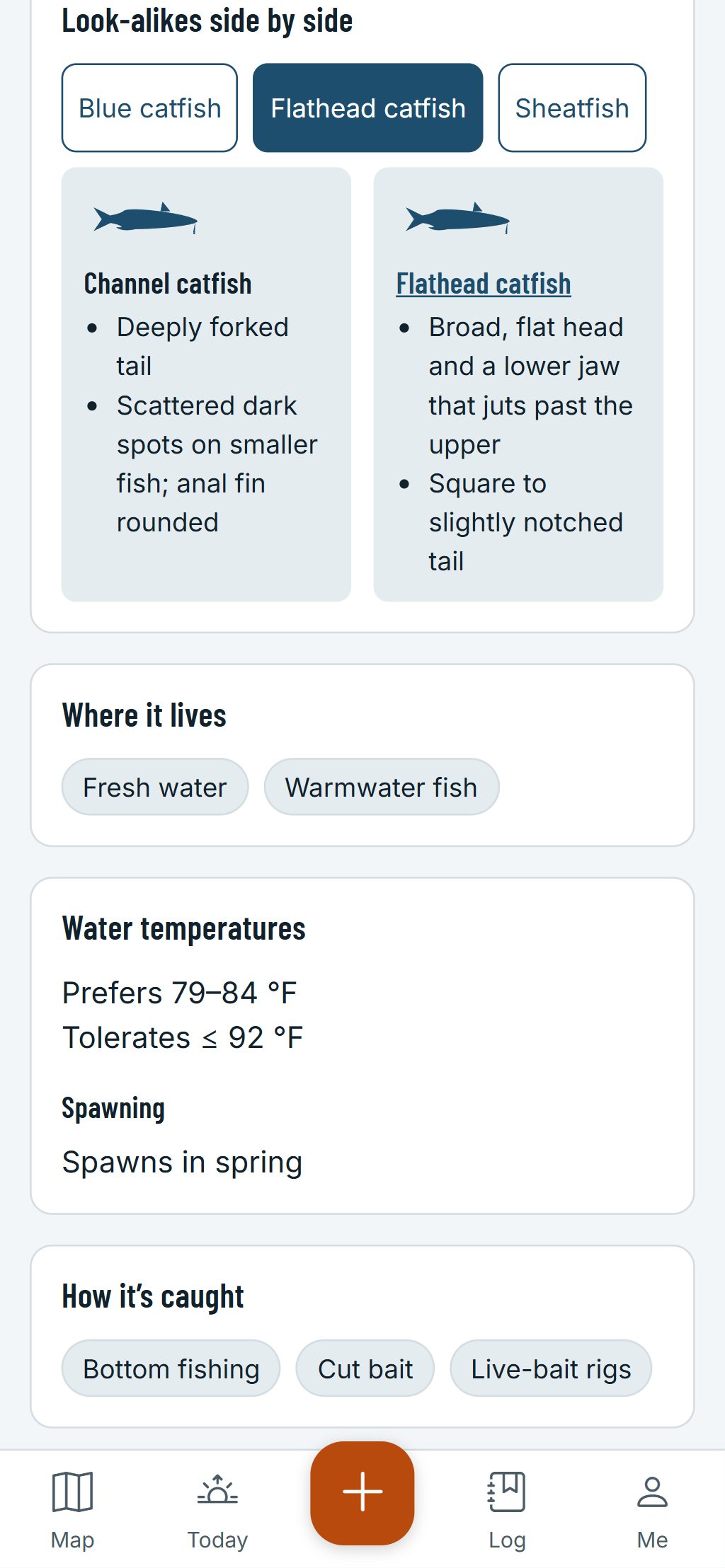
The species guide in HuntGrid Fishing works with no signal. Each species has its own page (open this species in the app):
- The marks that tell them apart: a channel catfish has a deeply forked tail and, when small, scattered dark spots; a flathead catfish has a broad, flat head, a lower jaw that juts past the upper and a square or slightly notched tail.
- The bullheads side by side: dark chin barbels on the brown and black bullheads, white to yellow ones on the yellow bullhead.
- Their habitat and the techniques that catch each one.
- The blue catfish beside the channel catfish, its look-alike in many big rivers.
- A question key: answer a few questions about the fish in your hand and it narrows down the candidates.
- Waters near you where agency surveys or stocking records show the species, with the year.
Catfish seasons and limits vary by state, province and water, and many rivers have rules of their own. HuntGrid never guesses them: the official regulations always have the final word.
How catfish anglers use HuntGrid Fishing
Holes, bends and log jams
Mark deep holes, outside bends, log jams and the water below a dam with fishing icons, with the depth, the bottom and the months each one fishes best. Filter your spots by species.
Log a catfish in three taps
Tap +, Catch, Channel catfish: the place and time are saved, even at night with no signal. Add the length and weight whenever you like.
Bottom rigs and night fishing
The how-to library shows the fish-finder, Carolina and three-way rigs, the snell knot for bait hooks, and how to fish rivers, reservoirs and at night, saved offline.
Depth maps
Depth shading and contours from agency lake surveys show the channels, holes and flats catfish use in lakes and reservoirs.
Bite forecast
Today scores the bite on your favourite waters and shows the best windows, with the reasons behind each score.
Can I keep it?
Fish Check gives the rules for a catfish of that length at that water today, with the official source.
Personal bests
Your biggest channel cat and flathead, by length and by weight.
Offline lakes and rivers
Download a lake or a stretch of river in one tap: its map and your spots work with zero bars.
Questions
Still have a question? Read the HuntGrid Fishing help pages or email support@huntgrid.net.
What is the best app for catfish?
The one that fits how you fish. HuntGrid Fishing keeps your holes private, logs a catch in three taps, even at night with no signal, and carries a species guide and a rig library that work offline. It’s free: try it on your own river before you decide.
How do I tell a channel catfish from a flathead?
Look at the tail and the head. A channel catfish has a deeply forked tail; a flathead’s is square or slightly notched, and its head is broad and flat, with a lower jaw that juts out.
How do I hold a catfish without getting spined?
Mind the stiff, sharp spines at the front of the dorsal and pectoral fins. Hold the fish firmly from above, behind those spines, or with a lip gripper. The how-to library shows how to handle and release a fish well.
Does HuntGrid Fishing show catfish limits?
Fish Check gives the rules for a catfish at a water on a date, with the official source. Rules a person hasn’t checked yet are labelled as not verified. The official regulations always have the final word.
Your next fishing trip starts on the map
Create a free account and open HuntGrid Fishing in your browser. The same account works for HuntGrid Hunt.
Already have an account? Sign in