 HuntGrid
Largemouth and smallmouth bass
The bass fishing app for largemouth and smallmouth
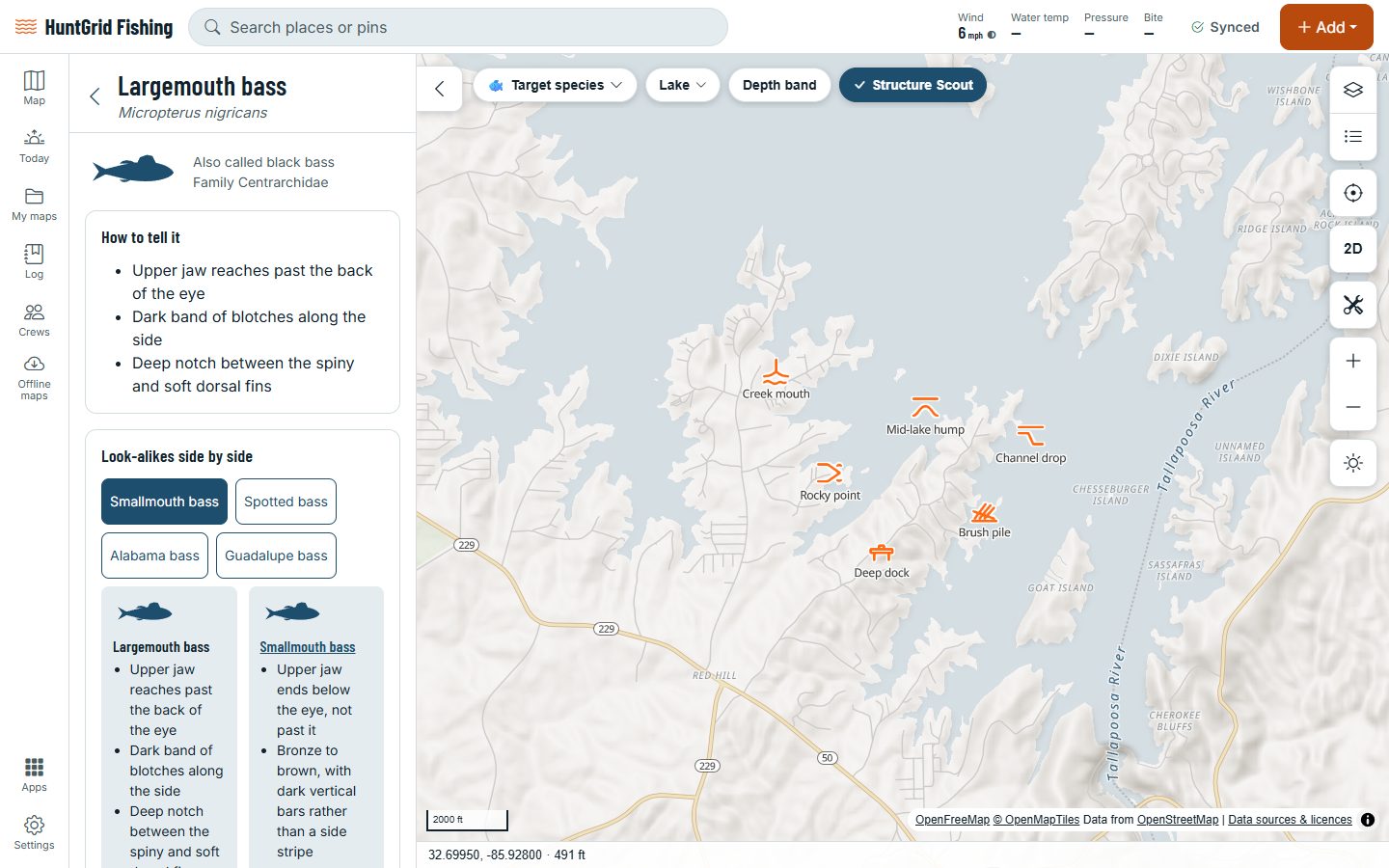
Largemouth hide in weeds and wood; smallmouth roam rock and current. HuntGrid Fishing keeps your bass spots private, logs every fish in three taps, and puts the rigs and the species guide in your pocket, even with no signal.
Map data © OpenStreetMap contributors, © OpenMapTiles; terrain: Copernicus WorldDEM-30 (credits)
Two bass, two habits
They often share a lake, but rarely the same spot.
Largemouth: cover and calm water
Largemouth bass like warm, weedy, slower water: lily pads, weed beds, fallen trees, docks and the shade they make. They ambush their prey from cover.
Smallmouth: rock and current
Smallmouth bass prefer clearer, cooler water with rock, gravel and current: rocky points, shoals, boulder flats and river runs.
Nests in the shallows
In late spring bass spawn in shallow water. The male fans out a nest and guards the eggs and then the young, and many waters have special rules for that time: check them.
Not true basses
Despite the name, both belong to the sunfish family, with crappies and bluegill, not to the true basses.
Map data © OpenStreetMap contributors, © OpenMapTiles; terrain: Copernicus WorldDEM-30 (credits)
Species guide
Largemouth or smallmouth? The guide shows you
The species guide in HuntGrid Fishing works with no signal. Each species has its own page (open this species in the app):
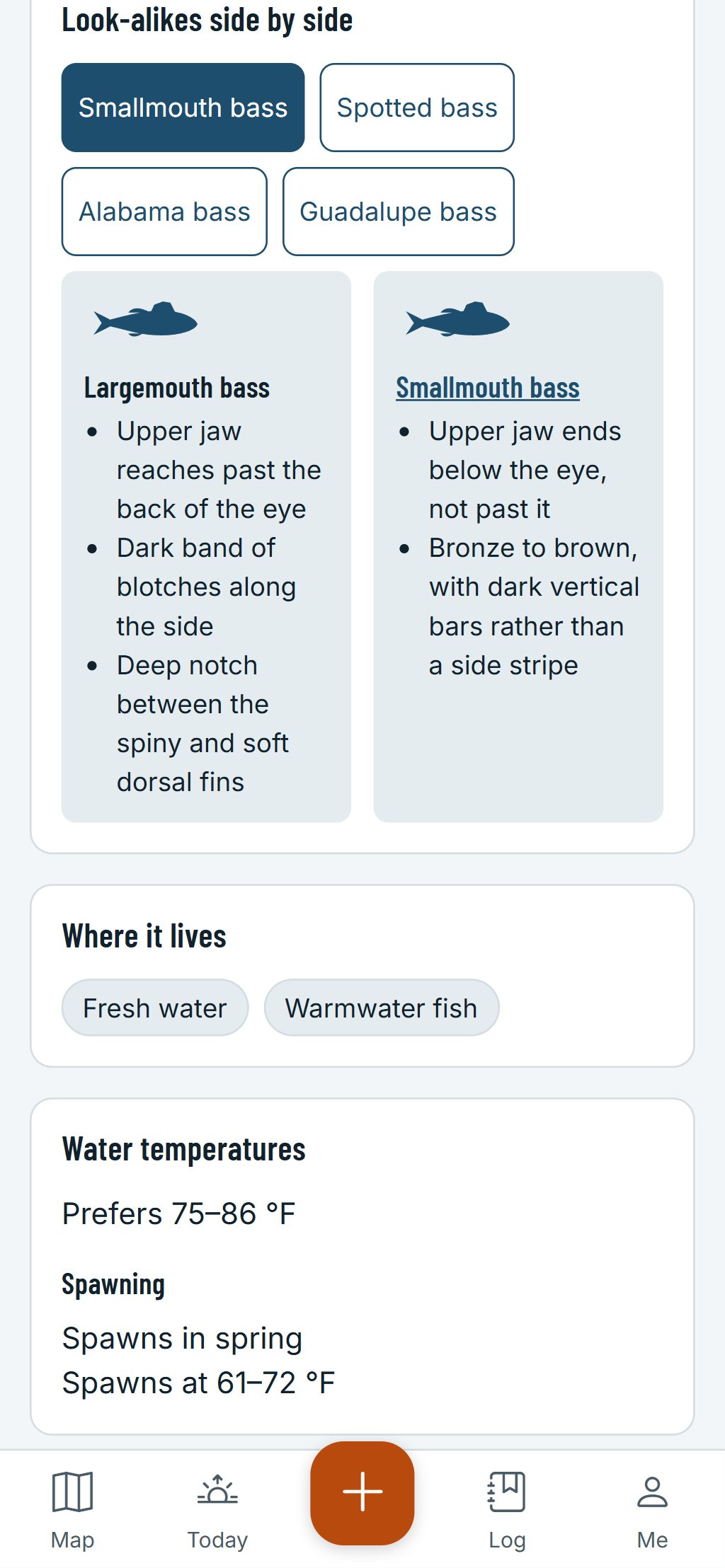
- The marks that tell them apart: a largemouth’s upper jaw reaches past the back of its eye; a smallmouth’s stops below the eye, and it wears dark vertical bars instead of a side band.
- Both side by side, so you can compare them on the water.
- Their habitat, the techniques that catch each one, and the water temperatures they prefer with their source.
- A question key: answer a few questions about the fish in your hand and it narrows down the candidates.
- Waters near you where agency surveys or stocking records show the species, with the year.
Bass seasons, size limits and catch-and-release periods vary by state, province and water. HuntGrid never guesses them: the official regulations always have the final word.
How bass anglers use HuntGrid Fishing
Spots with their details
Mark docks, weed edges, laydowns and rock piles with fishing icons, with the depth, the cover and the months each one fishes best. Filter your spots by species.
Log a bass in three taps
Tap +, Catch, Largemouth bass: the place and time are saved, even with no signal. Add a length and the app estimates the weight, marked “est.”
Soft-plastic rigs, step by step
The how-to library shows the Texas, wacky, Ned, drop shot and Carolina rigs and the knots to tie them, saved offline.
Depth maps
Depth shading and contours from agency lake surveys show the weed flats, points and drop-offs bass use through the year.
Structure Scout
Points, humps and inside turns are labelled with their depth: a short list of places for your first casts.
Bite forecast
Today scores the bite on your favourite waters and shows the best windows, with the reasons behind each score.
What’s working
Your tackle box shows which lures caught the most bass, and how fast, from your own log.
Club tournaments
Run a club tournament with photo entries and a live leaderboard; results never show where anyone fished.
Can I keep it?
Fish Check gives the rules for a bass of that length at that water today, with the official source.
Personal bests
Your biggest largemouth and smallmouth, by length and by weight.
Offline lakes and rivers
Download a lake or a stretch of river in one tap: its map and your spots work with zero bars.
Questions
Still have a question? Read the HuntGrid Fishing help pages or email support@huntgrid.net.
What is the best app for bass fishing?
The one that fits how you fish. HuntGrid Fishing keeps your bass spots private, logs a catch in three taps and carries a species guide and a rig library that work offline. It’s free: try it on your own lake before you decide.
How do I tell a largemouth from a smallmouth?
Close the fish’s mouth and look at the jaw: a largemouth’s upper jaw reaches past the back of its eye, a smallmouth’s doesn’t. Largemouth have a dark band of blotches along the side and a deep notch in the dorsal fin; smallmouth are bronze to brown with vertical bars.
Which rig should I start with?
Many anglers start with a soft plastic on a Texas rig around cover, and switch to a wacky or Ned rig when the bite is slow. The how-to library shows how to tie each one, offline.
Does HuntGrid Fishing show bass limits and seasons?
Fish Check gives the rules for bass at a water on a date, with the official source. Rules a person hasn’t checked yet are labelled as not verified. The official regulations always have the final word.
Your next fishing trip starts on the map
Create a free account and open HuntGrid Fishing in your browser. The same account works for HuntGrid Hunt.
Already have an account? Sign in