 HuntGrid
Redfish, seatrout, snook and stripers
The redfish and inshore fishing app
Inshore fish run on the tide: they push onto the flats and into the grass as the water rises, and line up at creek mouths as it falls. HuntGrid Fishing puts the tide in your pocket and works it out with no signal, keeps your spots private and logs every fish in three taps.
Map data © OpenStreetMap contributors, © OpenMapTiles; terrain: Copernicus WorldDEM-30 (credits)
Know the inshore fish
Different coasts, different fish, one clock: the tide.
Redfish and their spot
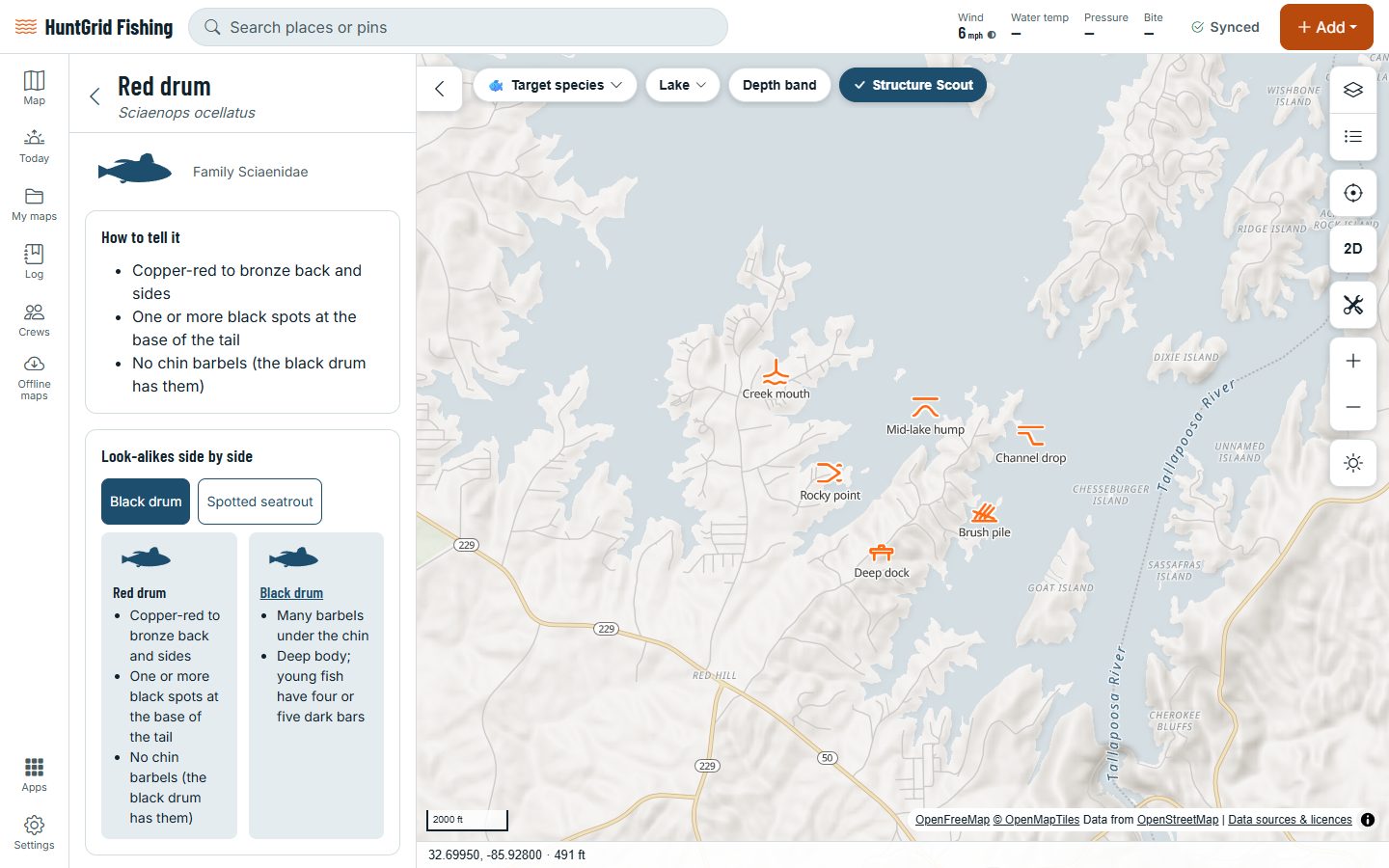
Red drum, called redfish, cruise grassy flats and oyster bars in water so shallow their tails can show as they feed. Most carry one or more black spots near the tail.
Seatrout, snook and tarpon
Spotted seatrout hunt over grass flats and channels; common snook hold under mangroves, docks and bridges; tarpon roll at the surface to gulp air. All three are fish of warm coasts.
Stripers and fluke up north
Farther north, striped bass and summer flounder work the same tides along beaches, rips, estuaries and inlets.
The tide sets the time
Moving water sweeps shrimp and baitfish past waiting fish, and slack water is often slow. Many inshore anglers plan around the tide first and the weather second.
Map data © OpenStreetMap contributors, © OpenMapTiles; terrain: Copernicus WorldDEM-30 (credits)
Species guide
Red drum or black drum? The guide shows you
The species guide in HuntGrid Fishing works with no signal. Each species has its own page (open this species in the app):
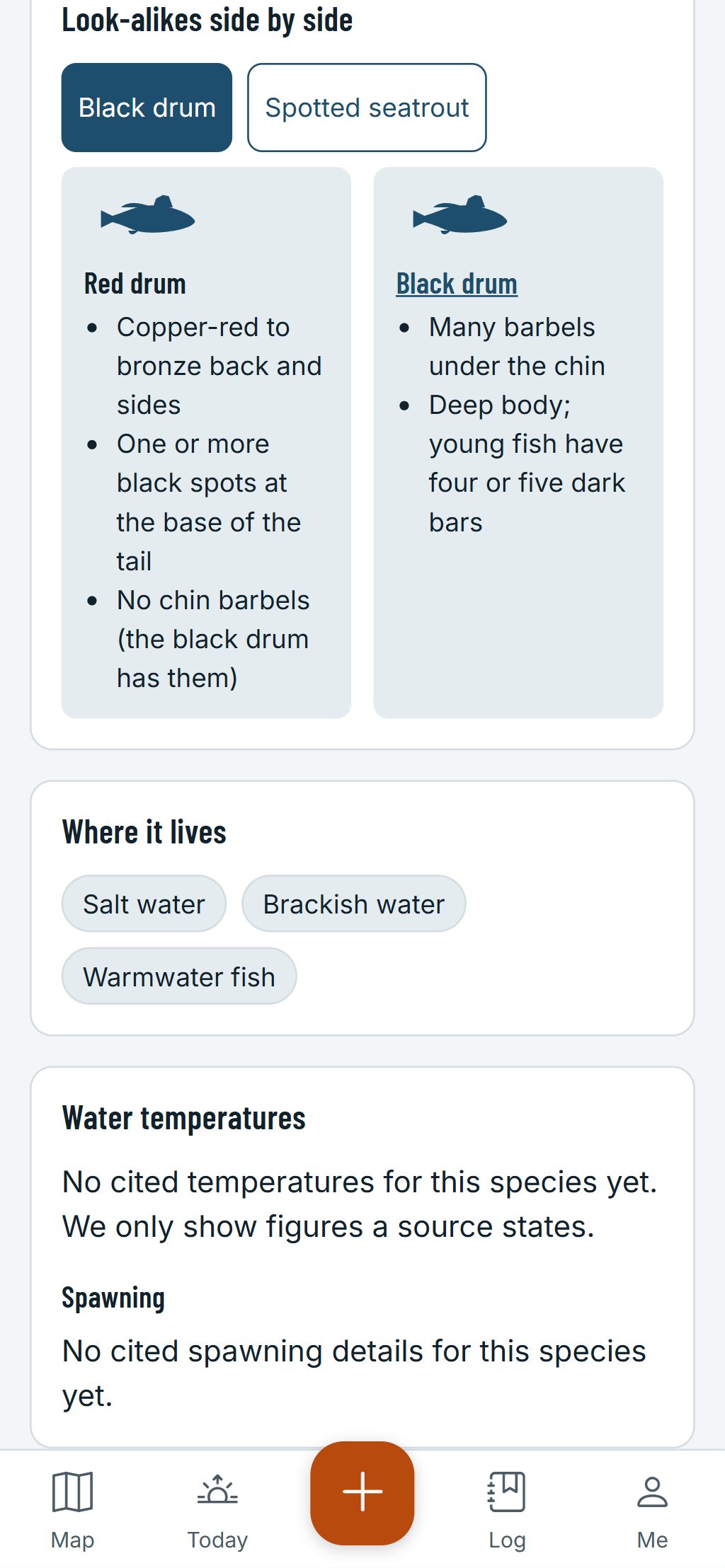
- The marks that tell them apart: a red drum is copper to bronze, with one or more black spots near the tail and no chin barbels; a black drum has a deeper body and many barbels under its chin.
- Look-alikes side by side, like the black drum and the sheepshead, or the summer flounder and its cousins.
- Their habitat, the techniques that catch each one, and the water temperatures the striped bass prefers with their source.
- A question key: answer a few questions about the fish in your hand and it narrows down the candidates.
- Waters near you where agency surveys or stocking records show the species, with the year.
Inshore rules change by state, province and species: size ranges, closed seasons and gear rules are common. HuntGrid never guesses them: the official regulations always have the final word.
How inshore anglers use HuntGrid Fishing
Tide charts that work offline
For NOAA tide stations in the US: the curve for today and three days either side, every high and low, and the tide clock, worked out on your phone, with no signal once the station is on it.
Flats, bars and creek mouths
Mark flats, oyster bars, docks and creek mouths with fishing icons, with the depth, the bottom and the winds and months each one fishes best. Filter your spots by species.
Log a redfish in three taps
Tap +, Catch, Red drum: the place and time are saved, even on a flat with no signal. Note whether you kept it or let it go.
Inshore rigs and knots, offline
The how-to library covers inshore waters, surf and piers, the slip float, Carolina and fish-finder rigs, and the FG knot for joining braid to a leader.
Tidal currents
NOAA current predictions, with arrows on the map scaled by speed and the slack windows.
Tide on the depth
Where the datums match, the depth readout adds the predicted tide.
When the flat has water
Draw a line across a flat or along a channel and see the hours today when the tide leaves your boat enough water, with a margin, wherever the depth survey and the tide station share a datum.
Go or no-go on the bay
Wind and waves hour by hour against your boat’s limits: Go, Caution or No-go, with the reasons. A second opinion, not a promise.
Can I keep it?
Fish Check gives the rules for a redfish or a striper of that length at that place today, with the official source.
Personal bests
Your biggest redfish, seatrout and striper, and the day you caught your first snook.
Questions
Still have a question? Read the HuntGrid Fishing help pages or email support@huntgrid.net.
What is the best app for inshore fishing?
The one that fits how you fish. HuntGrid Fishing has tide charts that work offline, keeps your flats and docks private, logs a catch in three taps and carries a species guide and a how-to library. It’s free: try it on your own bay before you decide.
Which tide is best for redfish?
Moving water is what counts. On a rising tide redfish push onto the flats and into the grass to feed; on a falling tide they wait at creek mouths, drains and channel edges for the bait coming out. Slack tide is often slow.
Do the tide charts work without cell service?
Yes, for stations already on your phone: the tide is worked out on the device from the station’s constants, for any date. Tide predictions aren’t for navigation: wind and air pressure move the water too.
Does HuntGrid Fishing show inshore limits and seasons?
Fish Check gives the rules for an inshore fish at a water on a date, with the official source. Rules a person hasn’t checked yet are labelled as not verified. The official regulations always have the final word.
Your next fishing trip starts on the map
Create a free account and open HuntGrid Fishing in your browser. The same account works for HuntGrid Hunt.
Already have an account? Sign in