 HuntGrid
Guide · HuntGrid Rockhounding
Can I collect here? How the answer works
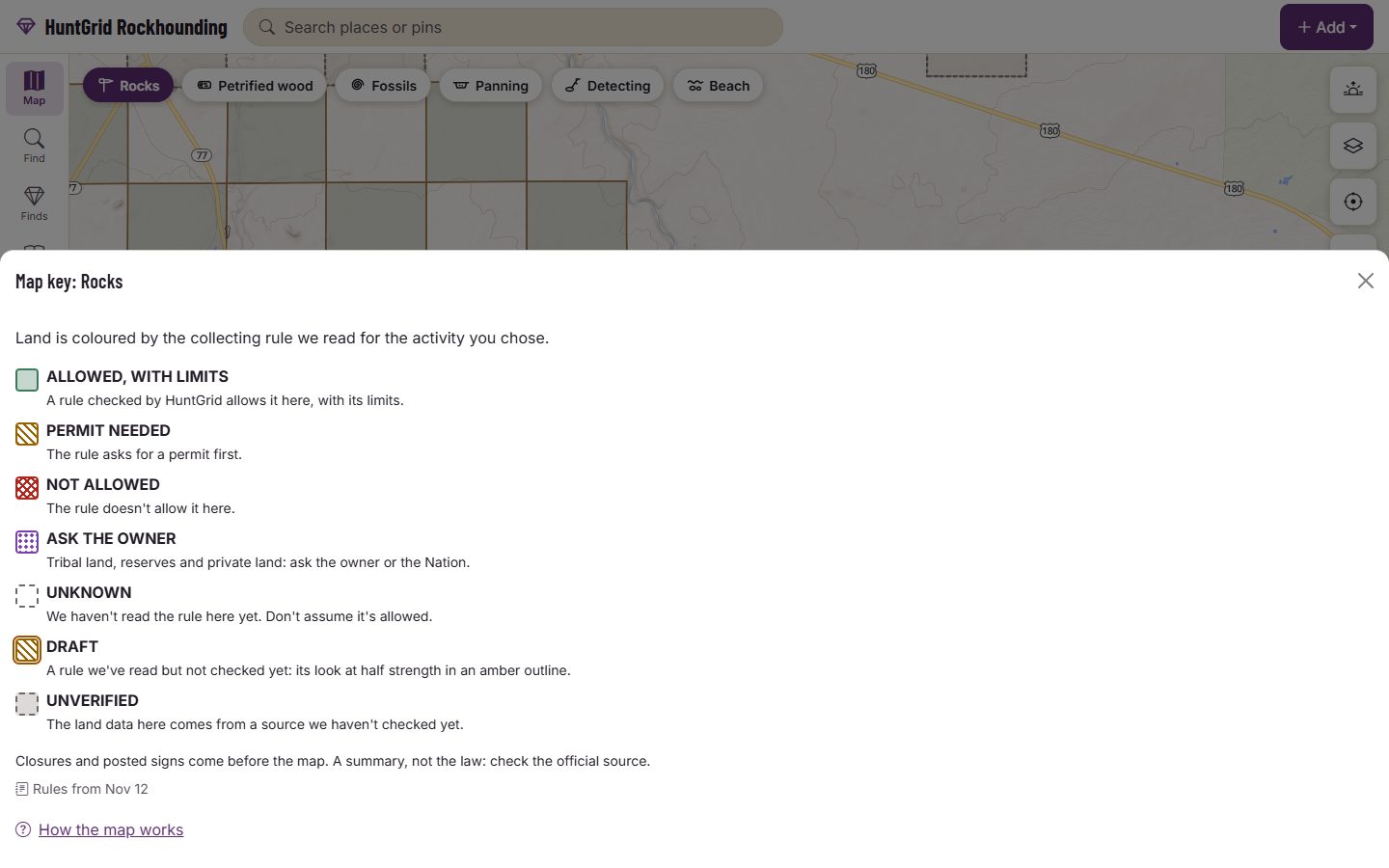
Tap a spot on the map and HuntGrid Rockhounding tells you who manages the land and what the collecting rule we read for it says, with its citation, its link and the day we read it. Here is what each word means, and what it doesn’t.
Map data © OpenStreetMap contributors, © OpenMapTiles; terrain: Copernicus WorldDEM-30 (credits)
The five answers
The map colours land by the rule for the activity you pick (rocks and minerals, petrified wood, fossils, gold panning, detecting or beach material), and a tap gives the same answer in words.
Allowed, with limits
A rule HuntGrid has checked allows it here. The limits it names (how much, what kind, what tools) come with it, and the app counts your finds against them.
Permit needed
The rule asks for a permit first. The answer names who issues it.
Not allowed
The rule doesn’t allow it here, as in national parks.
Ask the owner
Tribal land, First Nation reserves and private land: the Nation’s or the owner’s rules apply, and we don’t map them. Ask them.
Unknown
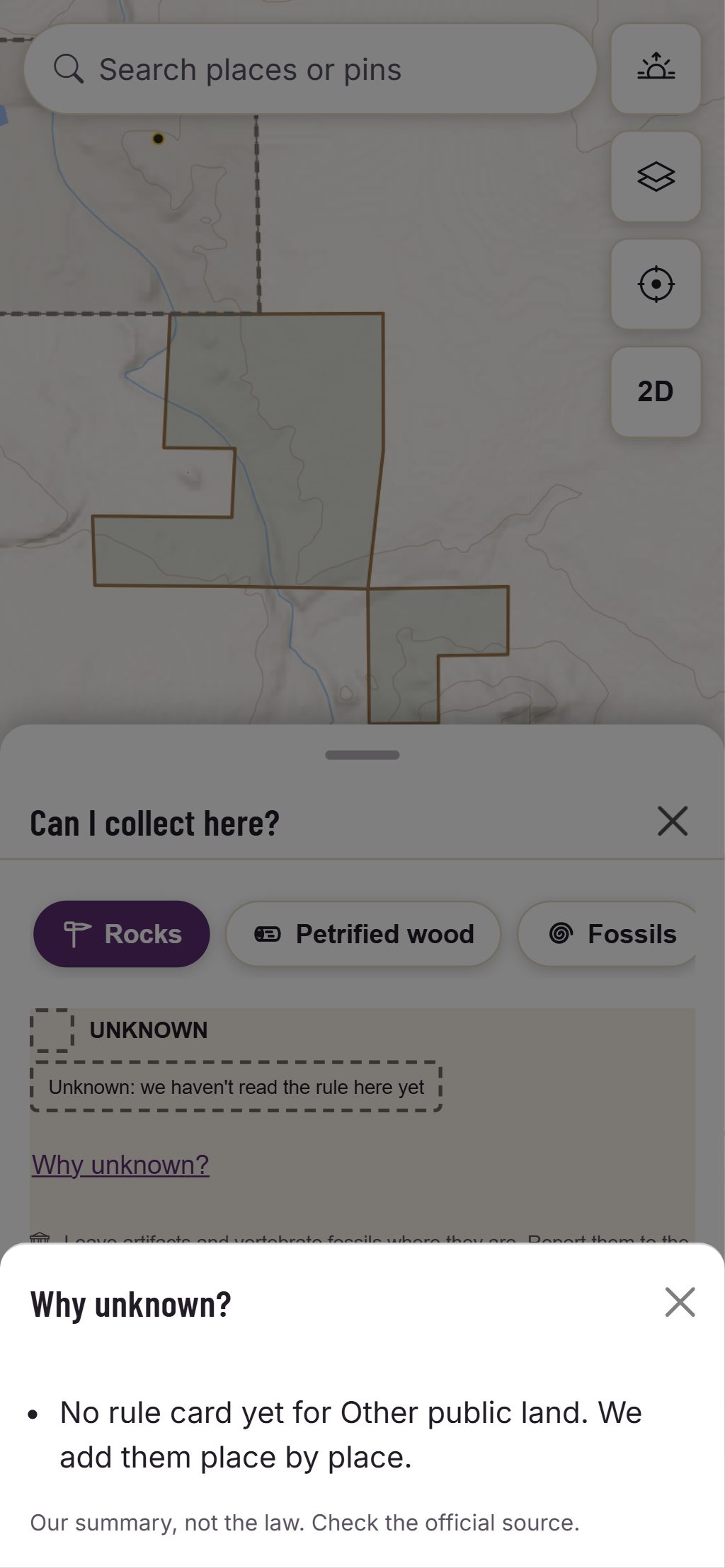
We haven’t read the rule here yet. Don’t assume it’s allowed: “Why unknown?” says what’s missing.
Draft and Unverified
Two looks say how far to trust an answer.
Draft
A rule we’ve read but HuntGrid hasn’t checked yet. On the map its colour is at half strength in an amber outline, and the answer says to check the official source.
Unverified
Some land data here comes from a source we haven’t checked yet, so who manages the land may be wrong. Check locally.
Map data © OpenStreetMap contributors, © OpenMapTiles; terrain: Copernicus WorldDEM-30 (credits)
Why unknown?
Why Unknown is common at first
We write each land manager’s rule card from its official source, place by place, and HuntGrid checks every card before the map shows it plainly. Until a place has a checked card, the map says Unknown rather than guess, and “Why unknown?” says what’s missing, in words like these:
- No rule card yet for the land manager in that place: we add them place by place.
- Rule drafted, waiting for HuntGrid’s check.
- A closure or order covers this spot.
- Tribal land or a First Nation reserve: the Nation’s rules apply. Ask the Nation.
- A mining claim may cover this spot.
- Partial park boundary: this area’s edge is only partly mapped.
Coverage grows as each state, province and federal manager is read, in a set order. An Unknown today can become an answer later; an answer never comes from a guess.
Mining claims on the map
Claims sit above the colours. A claim gives its holder rights to the minerals, so a rule that allows collecting on the land around it doesn’t reach inside it.
- Each claim shows its serial number, its status, the date of the data and how precisely its location is recorded, with a link to the agency’s case page.
- Many claims are recorded only to a survey section, so the edge on the map is approximate: the card says so.
- Where a claim may cover the spot, the answer says so. No claim in the data is never a promise that none exists: look for posted markers.
Information, not legal advice
- Each answer is our summary of a rule, beside its citation and link: the official source is the rule.
- Closures and posted signs come before the map, and the land manager has the final word.
- Artifacts and vertebrate fossils stay where they are wherever you collect, and old mines are for staying out of.
Questions
Still have a question? Read the HuntGrid Rockhounding help pages or email support@huntgrid.net.
Why does the map say Unknown where I know people collect?
Because we haven’t read and checked that land manager’s rule for that place yet, or the land data there is incomplete. “Why unknown?” on the spot says which. We’d rather say Unknown than guess.
Does the app work out the answer offline?
Yes, in an area you downloaded: the land, the claims and the rule cards are on your device, with the date they were saved.
Is it free?
Yes. The rules, claims and geology are never behind a paywall. HuntGrid Rockhounding is in open beta.
See what the rule says before you dig
Create a free account and open HuntGrid Rockhounding in your browser. The same account works for every HuntGrid app.
Already have an account? Sign in